

French Drain Installation in Wantagh, NY
Stop Water Damage Before It Starts — Professional Drainage Solutions for Wantagh Homeowners
Situated along Long Island's South Shore, Wantagh is one of those communities where the relationship between land and water is always close — sometimes too close. With the bay at its edge and a water table that reflects it, homeowners here deal with drainage challenges that are as consistent as the tides. French drain installation on Long Island is one of the most effective tools available for getting ahead of those challenges, and JT Masonry & Landscaping has been helping Nassau and Suffolk County homeowners do exactly that for over 15 years. What years of working in this region have made clear is that water problems left unaddressed don't plateau — they escalate. Foundation erosion, chronic basement moisture, saturated yards, and failing hardscaping are all predictable outcomes when groundwater has no managed path away from your property. A correctly installed french drain changes that equation entirely, redirecting water before it reaches the structures and spaces it damages most.

Contact JT Masonry and Landscaping!
Our team is ready to turn your vision into reality, creating stunning landscapes and enduring masonry structures.
Website Lead Form (Stone Veneers Page)

CLIENT REVIEWS
WHAT OUR CLIENTS ARE SAYING
JT Masonary and landscaping were exceptional right from the first point of contact to the completion of their work. The owner JUSTIN was very professional in the way he presented the work he was going to do. The workers were polite, efficient, and hard-working. And the results of their work was phenomenal! We are already considering them for another job. Thank you JUSTIN and Company.
We had a great experience with Justin and the crew at JT Masonry & Landscaping. We got a inground pool and pavers installed. They made it easy every step of the way from the planning stage to our first pool opening. We would definitely recommend this company to family and friends.


How French Drain Installation in Wantagh Solves Your Property's Biggest Water Problems
Wantagh homeowners already understand that water is a constant presence in this part of Long Island. What many don't realize is how much of the drainage trouble they experience originates underground, well before water becomes visible at the surface. The region's shallow water table, dense clay-based soil, and flat grade all work against natural drainage — and the result is ground that can only absorb so much before it gives way to pooling, seepage, and saturation.
A french drain is engineered specifically for conditions like these. By running a gravel-filled trench with a perforated pipe beneath the surface, the system intercepts groundwater at the subsurface level and routes it toward a designated discharge point — away from the foundation, patio, retaining walls, and any section of the yard that bears the cost of persistent moisture. Unlike surface drainage measures that manage water only after it's already pooled, a french drain works at the source, reducing pressure before damage has a chance to occur.
The downstream effects matter just as much. Soil that drains consistently doesn't erode the way saturated ground does, meaning the hardscape features built on top of it stay level and structurally sound. Mold conditions tied to excessive moisture are reduced. And outdoor spaces that currently become unusable after any significant rainfall are restored to function throughout the season.
For beautiful walkways that stand the test of time, contact JT Masonry and Landscaping, schedule an appointment or call us at: (516) 732-5133
What Our French Drain Installation Process Looks Like
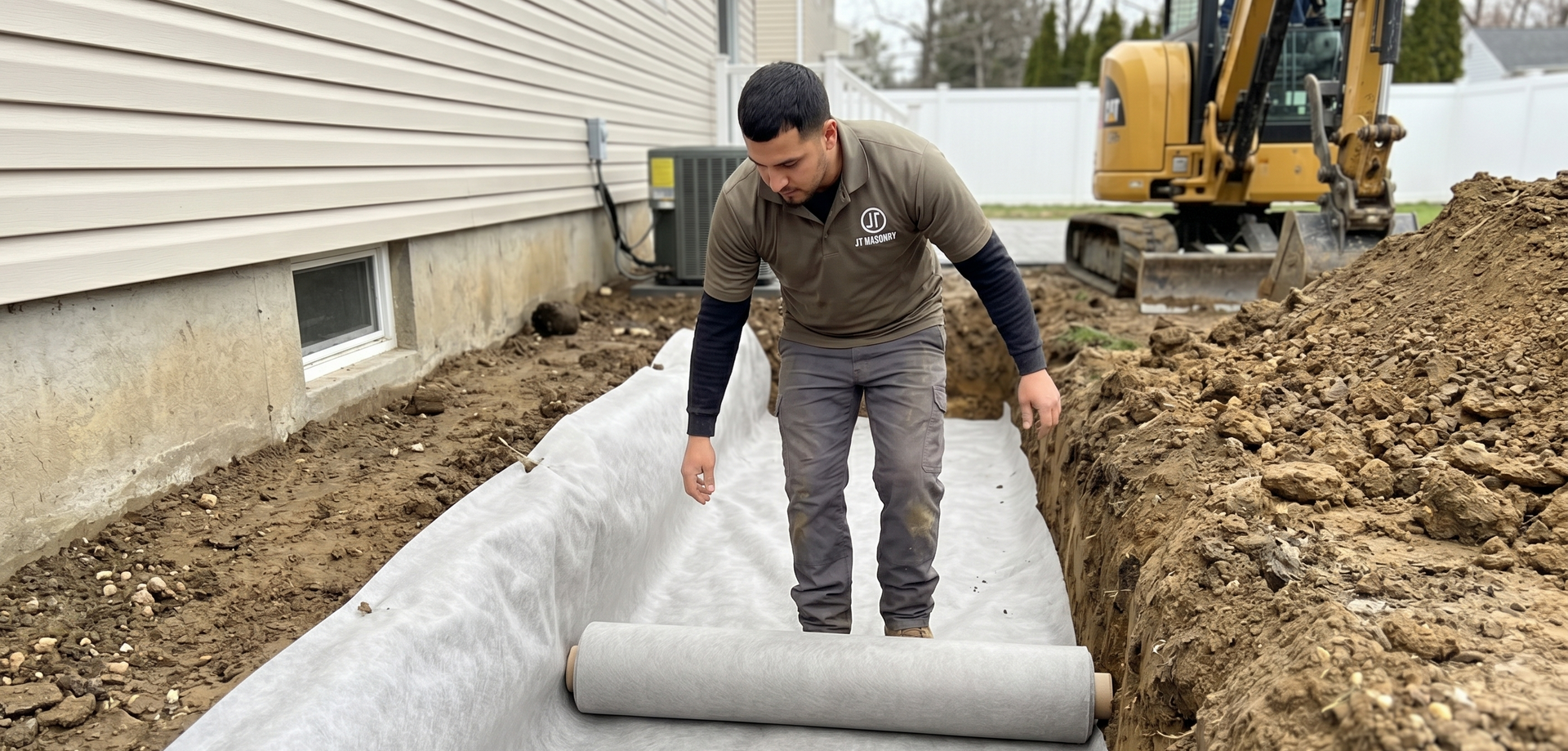
When JT Masonry & Landscaping takes on a french drain installation for a Wantagh homeowner, the process starts the same way every time — at your property, in person, before any equipment is involved. Water behavior varies from lot to lot based on grade, soil type, proximity to neighboring runoff, and existing landscape features. Understanding your specific conditions is what makes it possible to design a system that actually solves the problem. Here's what a professionally executed installation looks like from start to finish:
✔ Utility location and site preparation. An 811 utility locate is completed before the first inch of ground is broken. Gas lines, electrical conduit, and water supply pipes all need to be identified and marked — excavating without this step creates real risk and real liability.
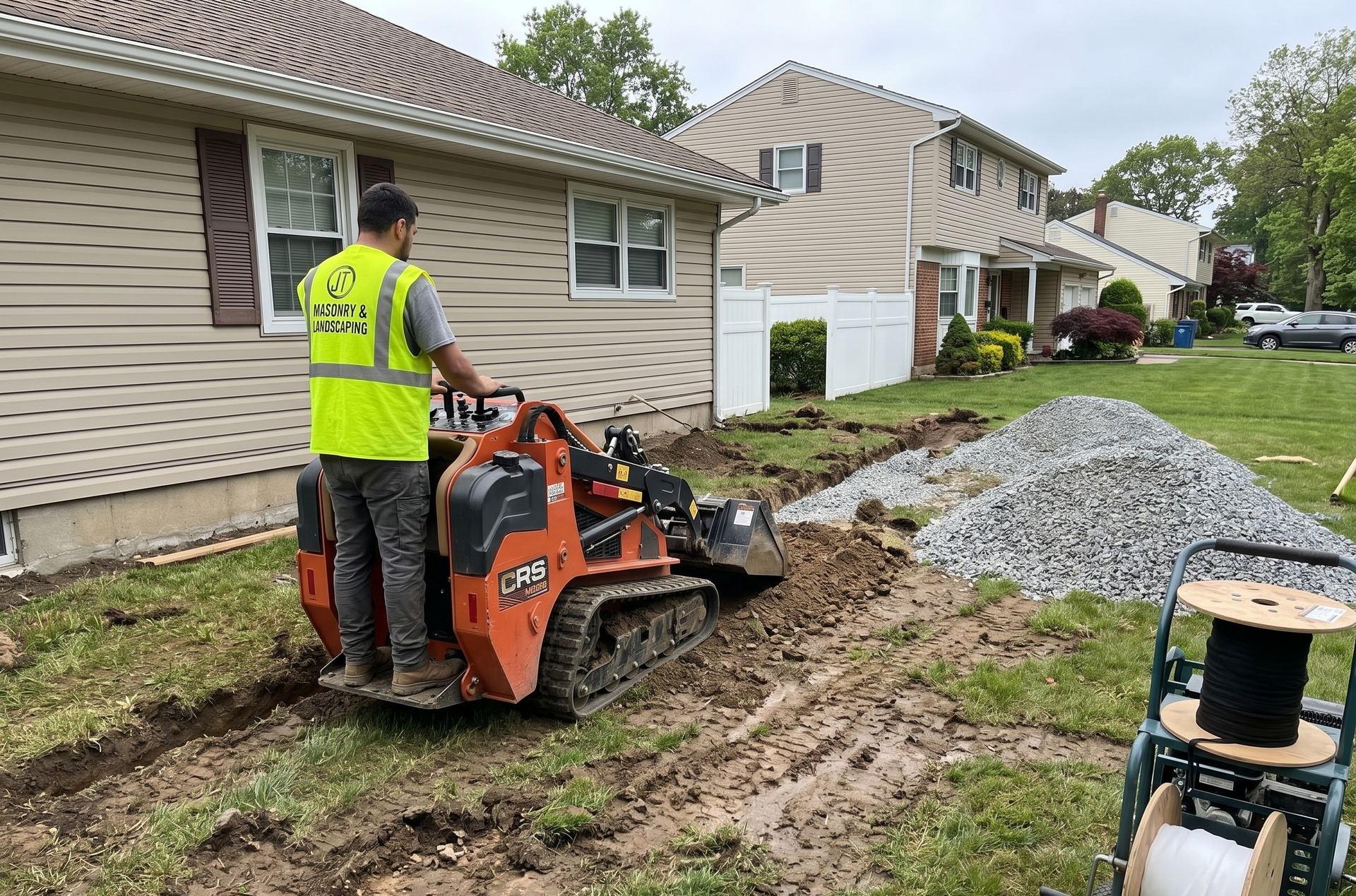
✔ Trench excavation along a calculated slope. The trench is cut to a standard depth of 18 to 24 inches and graded at no less than a 1% slope — approximately one inch of drop for every eight to ten feet of run — to keep water moving consistently toward the outlet rather than pooling inside the pipe.
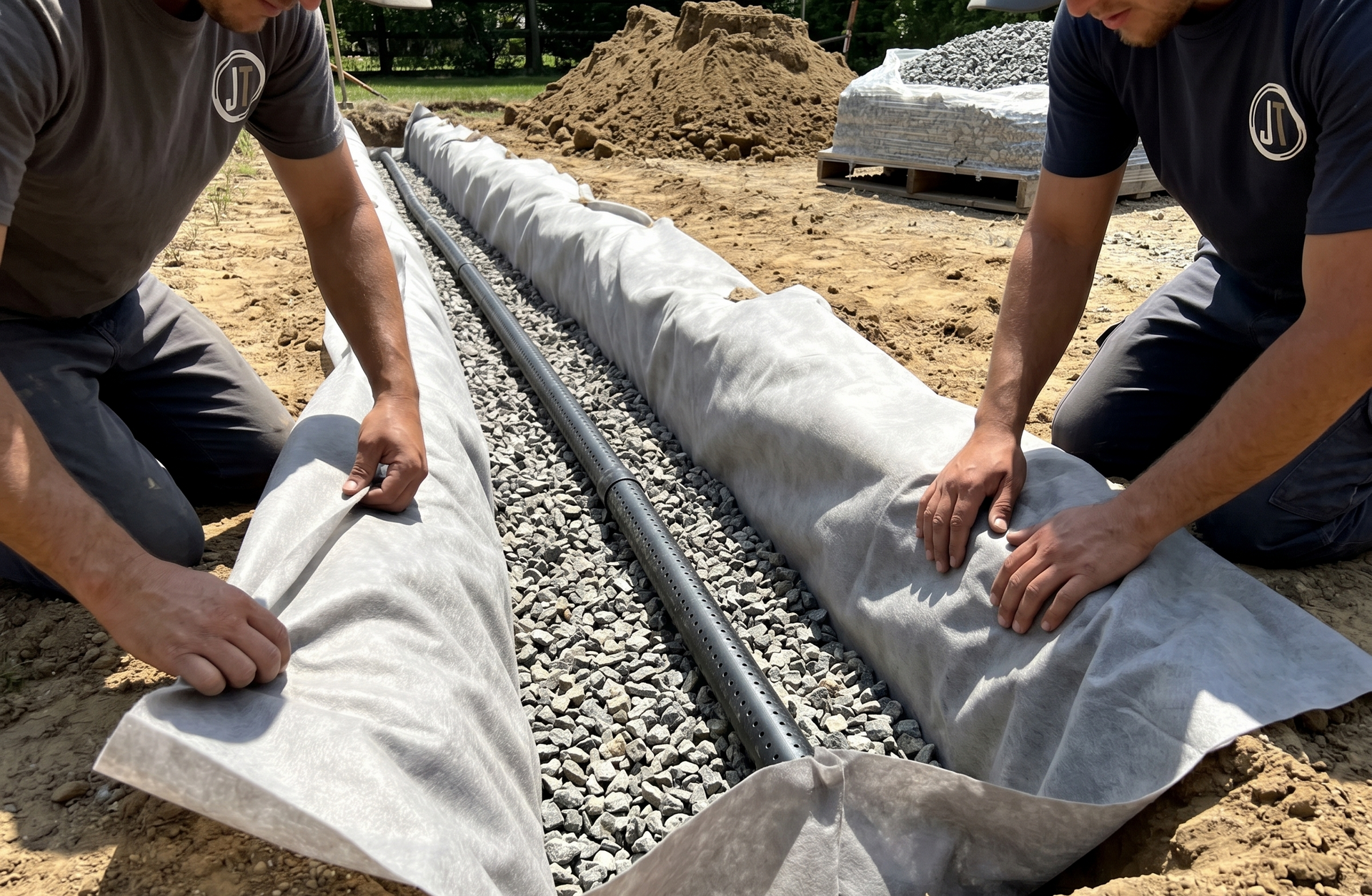
✔ Filter fabric lining. Nonwoven geotextile fabric is installed along the full interior of the trench before any gravel goes in. Its job is to block fine soil particles from infiltrating the drainage bed — without it, sediment accumulation gradually kills the system's performance.
✔ Gravel base and perforated pipe placement. A layer of washed gravel is placed first, then a rigid perforated pipe is set with its holes oriented downward for maximum water intake. Additional gravel fills around and over the pipe to complete the drainage bed.
✔ Proper discharge routing. Solid piping takes over near the outlet end of the system, carrying collected water to a safe release point — a dry well, drainage ditch, or pop-up emitter — positioned to protect both the home and adjacent properties.
✔ Wrap, backfill, and restoration. The filter fabric is folded over the gravel, the trench is backfilled and topped with sod, and the system disappears entirely into the landscape. The only thing visible afterward is a yard that drains properly.
Every one of these steps contributes to how long and how well the system performs. The trench grade, gravel type, and fabric installation aren't variables that can be approximated — they have to be executed correctly.
Frequently Asked Questions About French Drain Installation in Wantagh, NY
How long does a french drain installation take on a typical Long Island property?
The timeline for french drain installation depends on the length of the trench, the complexity of the routing, and the specific conditions of your property. Most residential installations on Long Island are completed within one to three days. During the initial consultation, JT Masonry provides a clear project timeline so you know exactly what to expect. We also coordinate around existing landscaping and hardscape features to minimize disruption to your yard during the process, and we leave the job site clean when the work is finished.
What type of pipe is used in a french drain?
Professional french drain installation typically uses rigid perforated PVC pipe or corrugated plastic pipe, usually 3.5 to 4 inches in diameter. At JT Masonry, the pipe selection is based on the volume of water the system needs to handle and the specific layout of your property. The perforated section of the pipe is installed with the holes facing downward, which allows groundwater to rise into the pipe from below rather than allowing soil sediment to fall in from above. The final section of the system transitions to solid pipe to carry collected water safely to the discharge point without any leakage along the way.
How much does french drain installation cost?
The cost of french drain installation varies based on several factors, including the total length of the trench, the depth required, soil conditions, accessibility of the work area, and the type of discharge point used. Because every Long Island property presents different challenges — from root systems and utility lines to soil composition and grade — we provide customized estimates rather than one-size-fits-all pricing. JT Masonry offers free on-site consultations where we evaluate your specific situation and provide a transparent, detailed estimate with no hidden fees. We also offer financing options to make drainage solutions accessible for homeowners.
Will a french drain damage my existing landscaping or hardscaping?
Some disruption to the yard surface is unavoidable during excavation, but a skilled installation crew minimizes the impact significantly. At JT Masonry, we carefully plan the trench route to avoid established plantings, irrigation lines, and hardscape features wherever possible. Once the french drain is installed and the trench is backfilled with soil and sod, the surface is restored and the system becomes virtually invisible. Our experience with both masonry and landscaping means we understand how to work around — and protect — the features you've already invested in, including patios, walkways, retaining walls, and pool areas.
How do I know if my property actually needs a french drain?
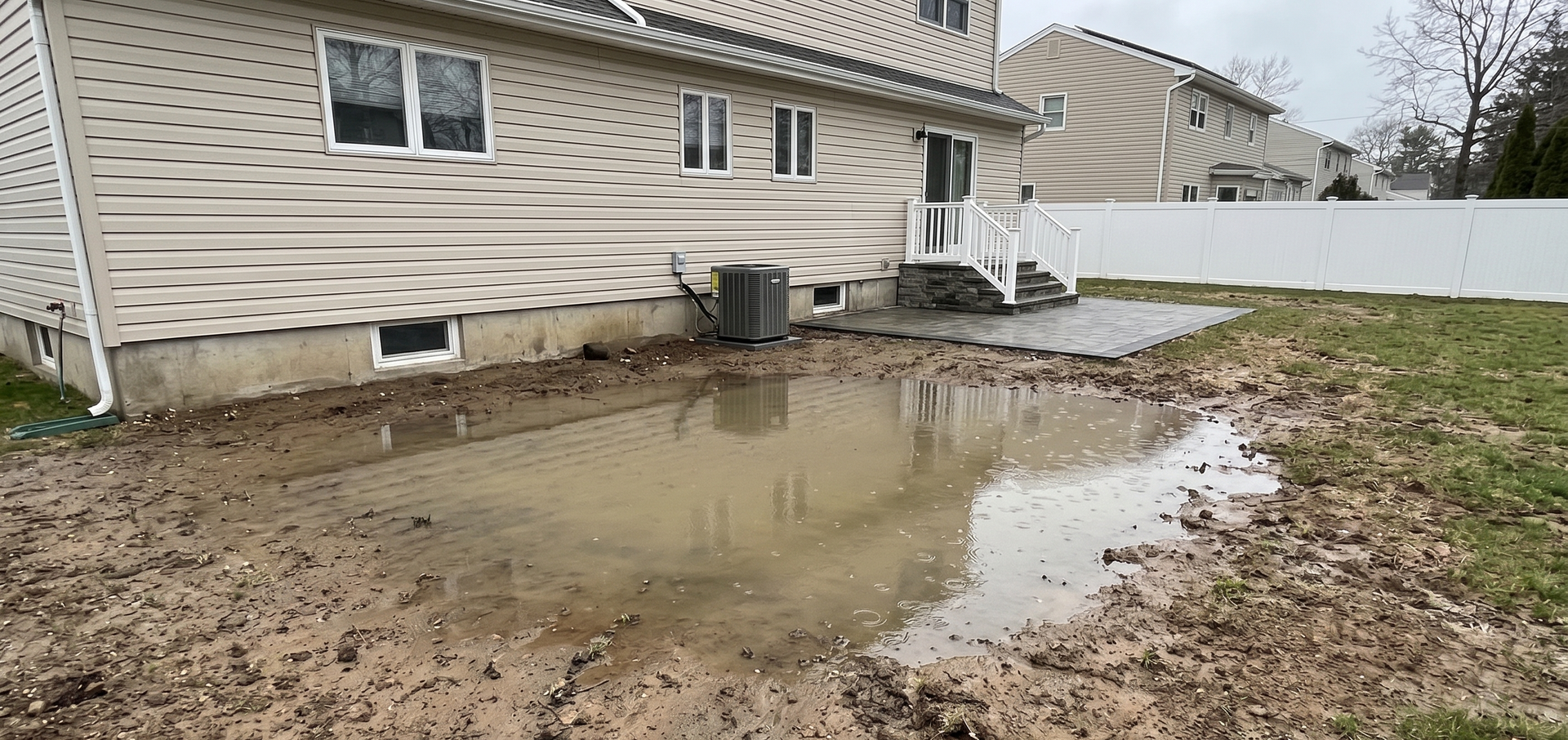
There are several reliable indicators that your property could benefit from french drain installation. Persistent standing water in your yard after rainstorms, damp or wet basement walls, efflorescence (white mineral deposits) on foundation surfaces, soggy or unusable sections of your lawn, and erosion around the base of your home or retaining walls are all signs that subsurface water isn't draining properly. If you've tried surface-level solutions like regrading or extending downspouts without lasting results, the problem is likely below the surface — which is exactly where a french drain operates. JT Masonry offers free property assessments to help you determine whether a french drain is the right solution for your specific drainage issue.ShareProject contentService Page Copy GeneratorCreated by youAdd PDFs, documents, or other text to reference in this project.
Why Wantagh Homeowners Trust JT Masonry for French Drain Installation
Picking a contractor for french drain installation comes down to more than who can put a pipe in the ground. The system has to be designed correctly for the specific property, built to last, and integrated thoughtfully with whatever else exists on the lot. Wantagh homeowners who work with JT Masonry & Landscaping choose us for reasons that hold up beyond the initial project:
✔ Regional expertise built over 15 years on Long Island. Drainage work in Nassau and Suffolk County means navigating specific soil types, a notoriously shallow water table, and municipal requirements that vary across townships. That's knowledge that only comes from working here consistently — not from applying generic drainage principles.
✔ A team that builds the full picture. French drains need to coexist with the rest of your outdoor environment. Because JT Masonry also constructs patios, retaining walls, walkways, and pool surrounds, our drainage designs are conceived with the entire property in mind — not isolated from the features they're meant to protect.
✔ Owner involvement on every project. The owner is your point of contact from the first phone call through the final walkthrough. No project managers relaying messages, no communication gaps between what was discussed and what gets built.
✔ Licensed, insured, and precise in how we scope work. Every project is evaluated and priced thoroughly before anything begins. Clear scope, no surprise additions.
✔ More than 200 completed projects across Long Island — a track record built on work that performs and homeowners who refer us to their neighbors.
Can I Install My Own French Drain in Wantagh?
The appeal of handling a french drain installation independently is understandable — but the margin for error is narrower than it appears on the surface. Trench slope has to be measured and maintained throughout the entire run; even a slight deviation can leave water sitting stagnant inside the pipe. Pipe diameter needs to match the anticipated volume of water the system will handle. Gravel selection affects both drainage rate and long-term resistance to sediment infiltration. And filter fabric, if installed improperly or skipped entirely, leaves the system vulnerable to exactly the kind of gradual clogging that quietly destroys performance over a few seasons.
Beyond the technical side, Wantagh properties carry the same underground utility risk as any Long Island community — gas lines, water mains, and electrical runs buried at varying depths that frequently fall within the range of drainage excavation. Professional french drain installation on Long Island treats utility location as a mandatory first step, not an optional precaution. The 811 call happens before any digging, and excavation proceeds only once what's underground is fully mapped.
For homeowners who want the drainage problem resolved — not just attempted — professional installation is consistently the approach that delivers results that hold up.
What Are the Downsides of a French Drain?
Going in with an honest understanding of what french drain installation involves is always worthwhile. The work requires excavation, which means a portion of your yard will be disrupted while the system is being built. That disruption is real, but it's also short-term and predictable. The cost of professional installation is another factor to weigh — though it shifts considerably in perspective when compared against what foundation repair, basement waterproofing, or structural hardscape reconstruction actually runs when water damage is allowed to develop unchecked.
Over the life of the system, a small amount of routine attention at the discharge point goes a long way. Debris can accumulate near the outlet, and tree roots can eventually work toward pipe runs if they're planted nearby. These aren't failures of the system — they're normal maintenance considerations that are easy to manage when the system was built correctly in the first place. Quality filter fabric installation and deliberate pipe routing decisions are the foundation of long-term performance, which is exactly why those details receive the care they do during a professional installation.
The trade-off is straightforward: a temporary disruption and a defined upfront cost, versus the compounding expense and structural risk of leaving a drainage problem to run its course. For most Wantagh homeowners who've weighed it honestly, that's not a difficult decision.
How Deep Should a French Drain Be Placed?
There's no universal depth specification for a french drain — the right answer depends on the problem the system is solving. Surface water management and general yard drainage typically require a trench depth of 18 to 24 inches, placing the perforated pipe below the root zone where it can capture subsurface water effectively. When the goal is foundation protection — what's often referred to as a footing drain — the trench may need to go considerably deeper, down to the level of the foundation footer, to intercept water before it reaches the structure. Width typically ranges from 9 to 12 inches, which provides adequate room for the gravel bed and pipe assembly without requiring unnecessary excavation.
In Wantagh, where the water table is notably close to the surface and South Shore conditions influence how groundwater behaves year-round, getting the depth right matters more than it might in a higher-elevation community. JT Masonry determines the appropriate configuration during our initial on-site consultation — factoring in soil conditions, the severity and pattern of the water issue, the drain's proximity to the home, and realistic discharge options on the property. Depth and design are decisions that have to be made at the lot level, and that assessment is how we make sure the system we build is built for the right job.
Who Benefits Most from French Drain Installation in Wantagh?
French drain installation on Long Island addresses a broader range of property situations than many homeowners initially assume — and in a South Shore community like Wantagh, where proximity to the water table is a year-round reality, the applications are especially relevant:
Recurring basement moisture or active water intrusion following heavy rainfall is one of the clearest signals that exterior drainage is failing. A french drain installed along the foundation perimeter captures groundwater before it ever builds pressure against the wall — resolving the issue at the source rather than treating symptoms inside the home. Yards with flat profiles or low-lying areas that collect standing water after storms and take days to recover are exactly the conditions a subsurface drainage system is designed to address, routing water away from the property consistently rather than allowing it to saturate the ground and surrounding plantings. Homeowners who have invested in patios, retaining walls, pool surrounds, or outdoor kitchens have additional reason to prioritize drainage — water-saturated soil undermines the structural base of every one of those features, and the shifting and cracking that follows is both costly and avoidable.
For any homeowner planning an outdoor construction or renovation project, there's no better time to incorporate french drain infrastructure than during the build itself — it's more efficient, less disruptive, and significantly more economical than coming back to add it later.
Long-Term Value of Professional French Drain Installation in Wantagh, NY
What a properly installed french drain leaves behind is a property that handles Long Island weather the way it should — reliably, season after season, without the recurring anxiety that comes with watching a storm roll in. The foundation is protected from hydrostatic pressure. The landscaping holds its form instead of eroding after every heavy rain. Patios, retaining walls, and outdoor living features remain stable because the ground supporting them stays consistent, not waterlogged and shifting beneath the surface.
For Wantagh homeowners specifically, where South Shore conditions mean water management is rarely a seasonal concern and more often a year-round one, that kind of baseline stability is genuinely valuable. It also registers with buyers. Home inspections surface drainage problems quickly, and properties where those problems have been professionally addressed carry a different weight in the market than those where they haven't. A french drain system done right is an improvement that works every day and communicates something meaningful about how the property has been maintained — and for homeowners thinking about both livability and long-term value, that combination is hard to match.
Get a Free French Drain Installation Estimate in
Wantagh, NY
Wantagh homeowners dealing with yard flooding, foundation moisture, or drainage that simply isn't keeping up with Long Island's rainfall don't have to keep waiting for conditions to improve on their own. JT Masonry & Landscaping provides free, on-site estimates for french drain installation across Nassau and Suffolk County, and Wantagh is squarely within the communities we serve. We'll assess your property directly, identify the root cause of the drainage issue, and put together a solution designed for the specific conditions of your lot — not a one-size-fits-all approach.
Call us at (516) 732-5133 or request your free estimate online. We'll be in touch within 24 hours.