

French Drain Installation in Syosset, NY
Stop Water Damage Before It Starts — Professional Drainage Solutions for Syosset Homeowners
Syosset is one of Nassau County's most sought-after communities — a Town of Oyster Bay address known for well-maintained properties, strong schools, and the kind of established neighborhoods where homeowners take their outdoor environments seriously. That investment in property upkeep makes it all the more frustrating when drainage problems quietly erode what's been built — and in Syosset, as throughout much of Nassau County, those problems have more to do with what's happening below grade than what's visible above it. French drain installation on Long Island is how JT Masonry & Landscaping helps Syosset homeowners protect their properties from the water-related damage that develops when groundwater has nowhere productive to go. With over 15 years working across Nassau and Suffolk County, the pattern we've observed holds regardless of neighborhood or property type: unmanaged subsurface water doesn't stay contained — it finds the nearest foundation, the weakest base beneath a patio, or the lowest point in a yard and settles in until the repair bill makes the problem impossible to ignore any longer.

Contact JT Masonry and Landscaping!
Our team is ready to turn your vision into reality, creating stunning landscapes and enduring masonry structures.
Website Lead Form (Stone Veneers Page)

CLIENT REVIEWS
WHAT OUR CLIENTS ARE SAYING
JT Masonary and landscaping were exceptional right from the first point of contact to the completion of their work. The owner JUSTIN was very professional in the way he presented the work he was going to do. The workers were polite, efficient, and hard-working. And the results of their work was phenomenal! We are already considering them for another job. Thank you JUSTIN and Company.
We had a great experience with Justin and the crew at JT Masonry & Landscaping. We got a inground pool and pavers installed. They made it easy every step of the way from the planning stage to our first pool opening. We would definitely recommend this company to family and friends.


How French Drain Installation in Syosset Solves Your Property's Biggest Water Problems
Syosset's inland position within Nassau County means its drainage challenges aren't tied to coastal groundwater or tidal influence — they come from the land's own characteristics. The clay-dominant soil that defines much of the Town of Oyster Bay absorbs water slowly, and when Long Island storm systems deliver rainfall at a rate that outpaces that absorption, water doesn't disperse — it backs up. It collects at low points, saturates the root zone, and eventually works its way toward anything below grade with enough persistence to cause structural damage over time. Add the impervious surfaces common to Syosset's developed residential streets — driveways, walkways, and paved areas that redirect water onto whatever permeable ground remains — and the conditions for chronic drainage problems are well established.
A french drain addresses this where it actually originates. Installed below the surface, the system uses a perforated pipe housed within a gravel bed to collect groundwater before it accumulates and channels it toward a discharge point chosen specifically to protect the property's most vulnerable features. Foundation walls, patio slabs, retaining structures, and low-lying yard sections all benefit from that redirection — because the system works at the subsurface level where water gathers, not at the surface where it's already visible and already causing harm.
The downstream effects reinforce each other over time. Soil that drains predictably provides the stable base that hardscape depends on to stay level and intact. Mold and efflorescence tied to basement moisture are eliminated at the exterior rather than addressed from inside the home. And the outdoor spaces that currently lose their usability after every significant storm reclaim their function for the full season.
For beautiful walkways that stand the test of time, contact JT Masonry and Landscaping, schedule an appointment or call us at: (516) 732-5133
What Our French Drain Installation Process Looks Like
Syosset properties vary in grade, soil density, lot configuration, and proximity to neighboring runoff in ways that make a site-specific assessment the only reliable starting point for french drain installation. What works on one street may need to be rethought entirely two blocks away. JT Masonry & Landscaping conducts a personal, in-person walkthrough at every property before any design is committed to — evaluating how water enters the lot, where it accumulates, what structures are at risk, and what discharge options the property can support. Once those conditions are understood, installation follows a defined process:
✔ An 811 utility locate is completed and all underground lines — gas, electrical, water, and irrigation — are identified and marked before excavation begins. This is a firm first step on every project and shapes how the dig is planned around existing subsurface infrastructure.
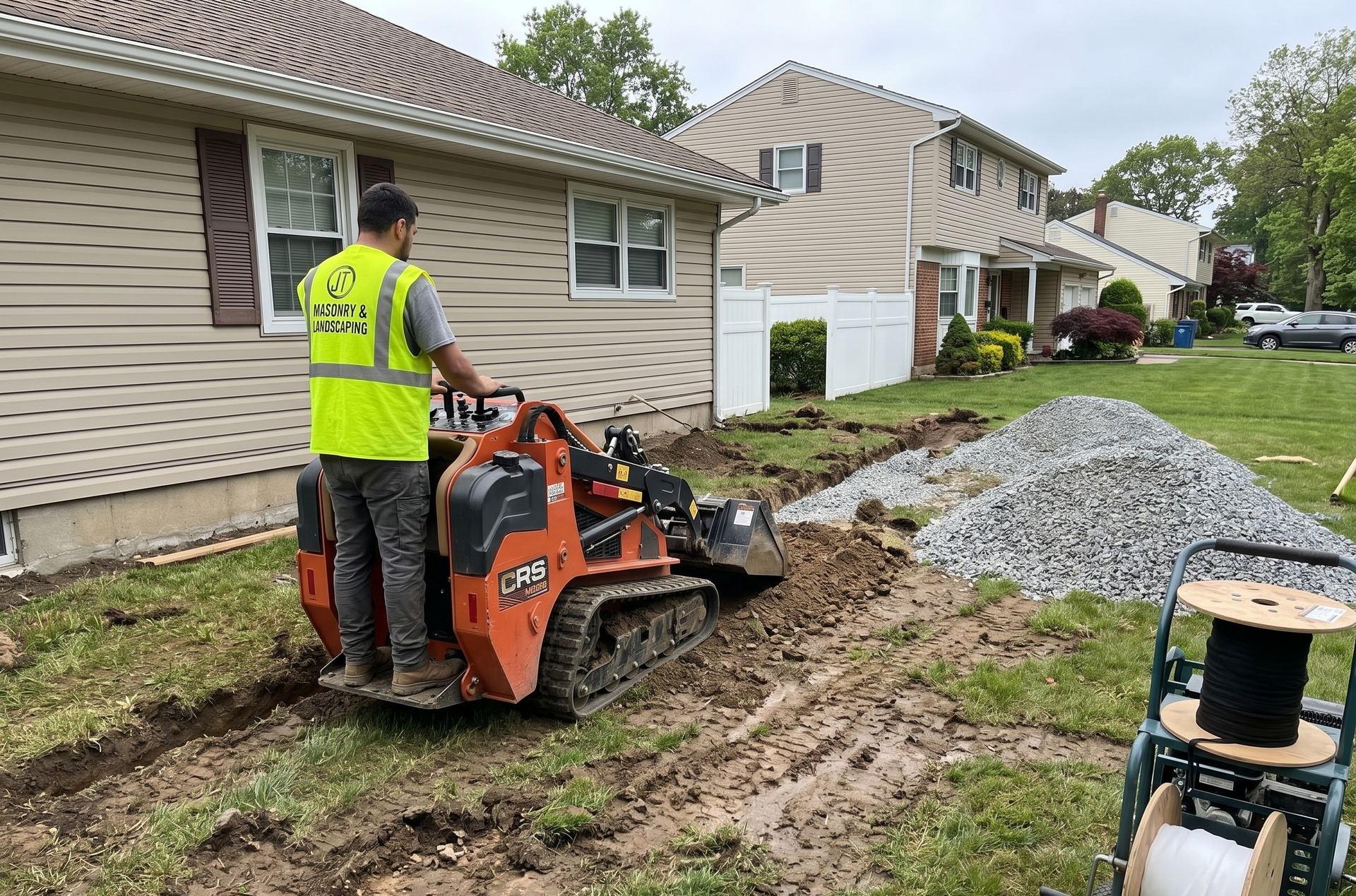
✔ The trench is cut to a working depth of 18 to 24 inches and graded at a minimum 1% slope — one inch of fall per eight to ten feet of run — maintaining the consistent pitch that keeps water moving through the pipe toward the outlet rather than pooling inside it.
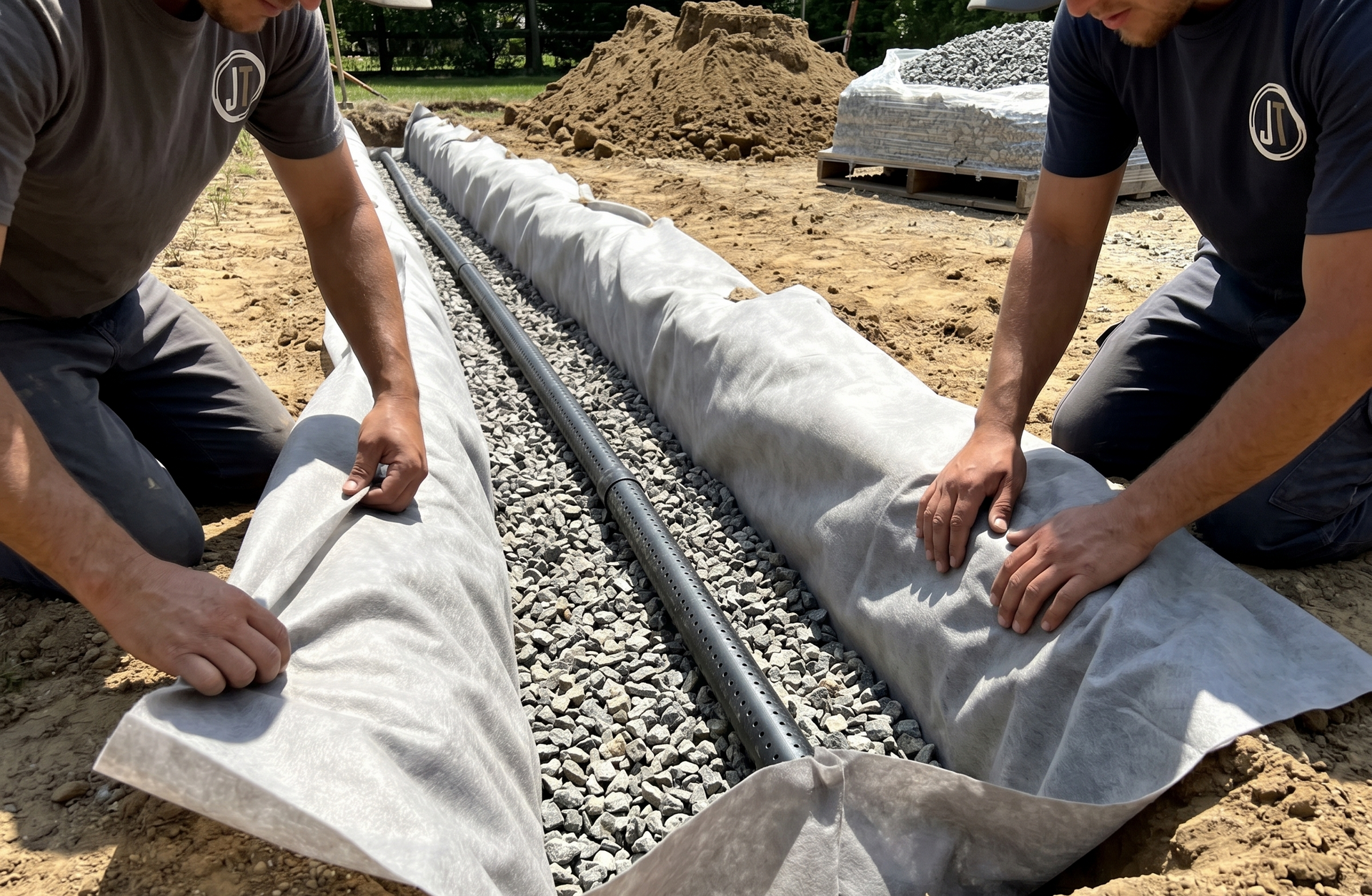
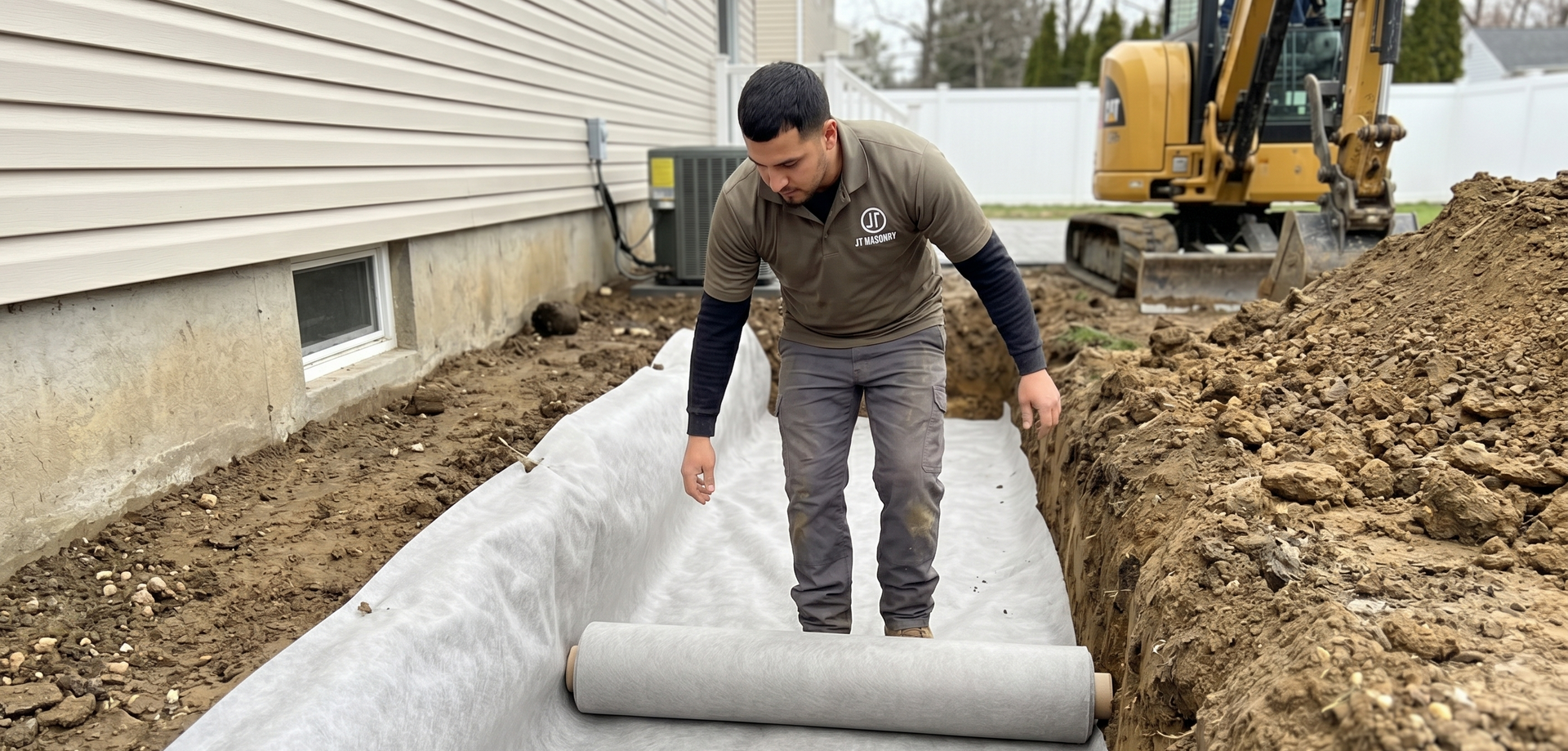
✔ Nonwoven geotextile fabric is laid throughout the full interior of the trench before gravel is introduced. This layer prevents fine soil particles from migrating into the drainage bed over time — the primary mechanism behind gradual capacity loss in systems where this step wasn't executed with full coverage and care.
✔ Washed gravel is placed to establish the drainage bed, followed by a rigid perforated pipe set with holes oriented downward to maximize water intake across the full length of the run. Gravel is compacted around and over the pipe to complete the assembly.
✔ As the system approaches the outlet, the perforated pipe transitions to solid piping that carries collected water to a designated discharge point — a dry well, pop-up emitter, or drainage ditch — positioned to remove water from the property without affecting neighboring lots or conflicting with local code requirements.
✔ The geotextile fabric is folded over the top of the gravel bed, the trench is backfilled with soil, and sod is restored over the surface. Once complete, the system is entirely invisible — the only evidence it's there is a property that drains the way it should.
The slope calculation, gravel specification, and fabric installation are invisible once the ground is closed — but they're the decisions that determine whether this system is still performing at full capacity five and ten years from now.
Frequently Asked Questions About French Drain Installation in Syosset, NY
How long does a french drain installation take on a typical Long Island property?
The timeline for french drain installation depends on the length of the trench, the complexity of the routing, and the specific conditions of your property. Most residential installations on Long Island are completed within one to three days. During the initial consultation, JT Masonry provides a clear project timeline so you know exactly what to expect. We also coordinate around existing landscaping and hardscape features to minimize disruption to your yard during the process, and we leave the job site clean when the work is finished.
What type of pipe is used in a french drain?
Professional french drain installation typically uses rigid perforated PVC pipe or corrugated plastic pipe, usually 3.5 to 4 inches in diameter. At JT Masonry, the pipe selection is based on the volume of water the system needs to handle and the specific layout of your property. The perforated section of the pipe is installed with the holes facing downward, which allows groundwater to rise into the pipe from below rather than allowing soil sediment to fall in from above. The final section of the system transitions to solid pipe to carry collected water safely to the discharge point without any leakage along the way.
How much does french drain installation cost?
The cost of french drain installation varies based on several factors, including the total length of the trench, the depth required, soil conditions, accessibility of the work area, and the type of discharge point used. Because every Long Island property presents different challenges — from root systems and utility lines to soil composition and grade — we provide customized estimates rather than one-size-fits-all pricing. JT Masonry offers free on-site consultations where we evaluate your specific situation and provide a transparent, detailed estimate with no hidden fees. We also offer financing options to make drainage solutions accessible for homeowners.
Will a french drain damage my existing landscaping or hardscaping?
Some disruption to the yard surface is unavoidable during excavation, but a skilled installation crew minimizes the impact significantly. At JT Masonry, we carefully plan the trench route to avoid established plantings, irrigation lines, and hardscape features wherever possible. Once the french drain is installed and the trench is backfilled with soil and sod, the surface is restored and the system becomes virtually invisible. Our experience with both masonry and landscaping means we understand how to work around — and protect — the features you've already invested in, including patios, walkways, retaining walls, and pool areas.
How do I know if my property actually needs a french drain?
There are several reliable indicators that your property could benefit from french drain installation. Persistent standing water in your yard after rainstorms, damp or wet basement walls, efflorescence (white mineral deposits) on foundation surfaces, soggy or unusable sections of your lawn, and erosion around the base of your home or retaining walls are all signs that subsurface water isn't draining properly. If you've tried surface-level solutions like regrading or extending downspouts without lasting results, the problem is likely below the surface — which is exactly where a french drain operates. JT Masonry offers free property assessments to help you determine whether a french drain is the right solution for your specific drainage issue.ShareProject contentService Page Copy GeneratorCreated by youAdd PDFs, documents, or other text to reference in this project.
Why Syosset Homeowners Trust JT Masonry for French Drain Installation
Selecting the right contractor for french drain installation matters most after the project is finished — when the system either holds up under Long Island weather conditions or reveals the shortcuts that were taken during installation. Syosset homeowners who work with JT Masonry & Landscaping consistently point to the same reasons for choosing us:
✔ 15 years of applied experience across Nassau and Suffolk County. Understanding how drainage behaves differently across Long Island's varied soil profiles, water table conditions, and municipal requirements isn't knowledge that transfers from another region — it accumulates through years of consistent work here, and it's embedded in every system we design.
✔ Full outdoor construction capabilities that shape how drainage is designed. Patios concentrate runoff at their edges. Retaining walls interact with subsurface water pressure. Driveways redirect significant volumes of storm water onto adjacent permeable surfaces. Because JT Masonry builds those features directly, our drainage systems are designed with the full property context in mind — not in isolation from the outdoor environment surrounding them.
✔ The owner manages every project from start to finish. From the initial site visit through final inspection, you work directly with the owner — no project coordinators filtering communication between the consultation and the crew. The continuity of that involvement is how project details stay intact from agreement to execution.
✔ Licensed, insured, and fully transparent on scope before work begins. Every project is evaluated and priced in detail upfront. Scope is defined clearly, and nothing gets added mid-project that wasn't part of the original conversation.
✔ A completed project portfolio of 200+ Long Island homeowners spanning drainage, masonry, and outdoor construction — built on work that performs over time and clients who refer their neighbors.
Can I Install My Own French Drain in Syosset?
The case for professional french drain installation isn't built on complexity for its own sake — it's built on the precision that the work requires and the consequences of falling short of it. Trench slope is the variable most commonly underestimated: the grade has to be held accurately and consistently from one end of the run to the other, because a section that flattens out creates a low point where water stalls. A pipe holding standing water has stopped functioning as a drainage system. Gravel gradation affects how freely water enters the bed and how resistant the system is to the long-term sediment infiltration that erodes capacity invisibly over time. Pipe diameter matched incorrectly to expected water volume handles routine rainfall adequately but fails during the storm events the system was built to address. And filter fabric applied without full coverage allows the fine particle migration that degrades performance in ways that aren't detectable until the system is already compromised.
These failure points are predictable — and they show up regularly in installations that were approached without the precision the work demands. In Syosset, where clay soil limits natural drainage from the outset and the system is working against those conditions from the moment it's installed, getting those details right matters more than it might on a more naturally permeable site.
The utility question applies equally here. Gas service, electrical runs, water mains, and irrigation lines run at depths throughout Syosset's developed residential streets that regularly intersect with drainage excavation ranges. Professional french drain installation on Long Island means the 811 locate is completed before any cut is made, every line is documented, and the excavation proceeds with a complete picture of what's underground. That process is the baseline standard on every project — not a precaution reserved for more complex jobs.
What Are the Downsides of a French Drain?
Having a clear picture of what french drain installation involves leads to better planning and a more straightforward project experience overall. The work is inherently subsurface, which means excavation is unavoidable — the section of the yard directly above the trench run will be temporarily out of commission while the system is being built. For Syosset homeowners with invested outdoor spaces, understanding the restoration scope before work begins is worth addressing directly during the initial consultation. The cost of professional installation is the other variable to consider in full context: foundation remediation, structural hardscape repair, and basement waterproofing are among the most disruptive and expensive property interventions available, and they're routinely the downstream result of drainage problems that were correctable far more economically before the damage reached that stage.
Systems built with quality materials and proper technique are designed to be low-demand over time, but the discharge outlet benefits from occasional attention across the life of the installation. Debris accumulation at the outlet end and root intrusion near the pipe run are the most common sources of reduced flow in systems that were otherwise installed correctly — and both are manageable when the original pipe routing and fabric application were done with care. Those decisions made at the start of the project are what keep long-term maintenance minimal and performance consistent year after year.
The underlying trade-off doesn't change regardless of the property: a temporary disruption and a defined upfront investment, against structural and financial damage that compounds when a water problem is left to develop without intervention.
How Deep Should a French Drain Be Placed?
Depth requirements for a french drain follow from the problem the system is being asked to solve, not from a standard specification applied uniformly across every project. For general yard drainage and subsurface water management, a trench depth of 18 to 24 inches positions the perforated pipe below the root zone and within range of the subsurface water that needs to be intercepted. Foundation drainage is a different target: the trench has to reach the level of the foundation footer to cut off groundwater before hydrostatic pressure builds against the structure, and for homes across Syosset — where construction periods and foundation configurations vary across individual properties — that depth needs to be verified at each address rather than assumed. Trench width falls between 9 and 12 inches in most applications, providing adequate space for the gravel bed, pipe, and surrounding fill without creating more disruption to the surrounding landscape than the work requires.
For Syosset properties, where clay soil density and variable lot configurations can influence both how deep groundwater sits and how it moves toward structures, JT Masonry works through the depth and configuration questions during the initial on-site consultation before any design is finalized. Soil conditions, the severity and pattern of the water problem, the drain's intended position relative to the home, and the discharge options the property can realistically support all factor into the final design. Those variables don't produce the same answer twice, which is precisely why accurate depth decisions require an assessment conducted at the specific property rather than selected in advance of seeing it.
Who Benefits Most from French Drain Installation in Syosset?
French drain installation on Long Island addresses a broad range of drainage situations — and in a community like Syosset, where clay soil and residential density combine to limit how much water the ground can handle after a storm, the scenarios that point toward a french drain are encountered regularly:
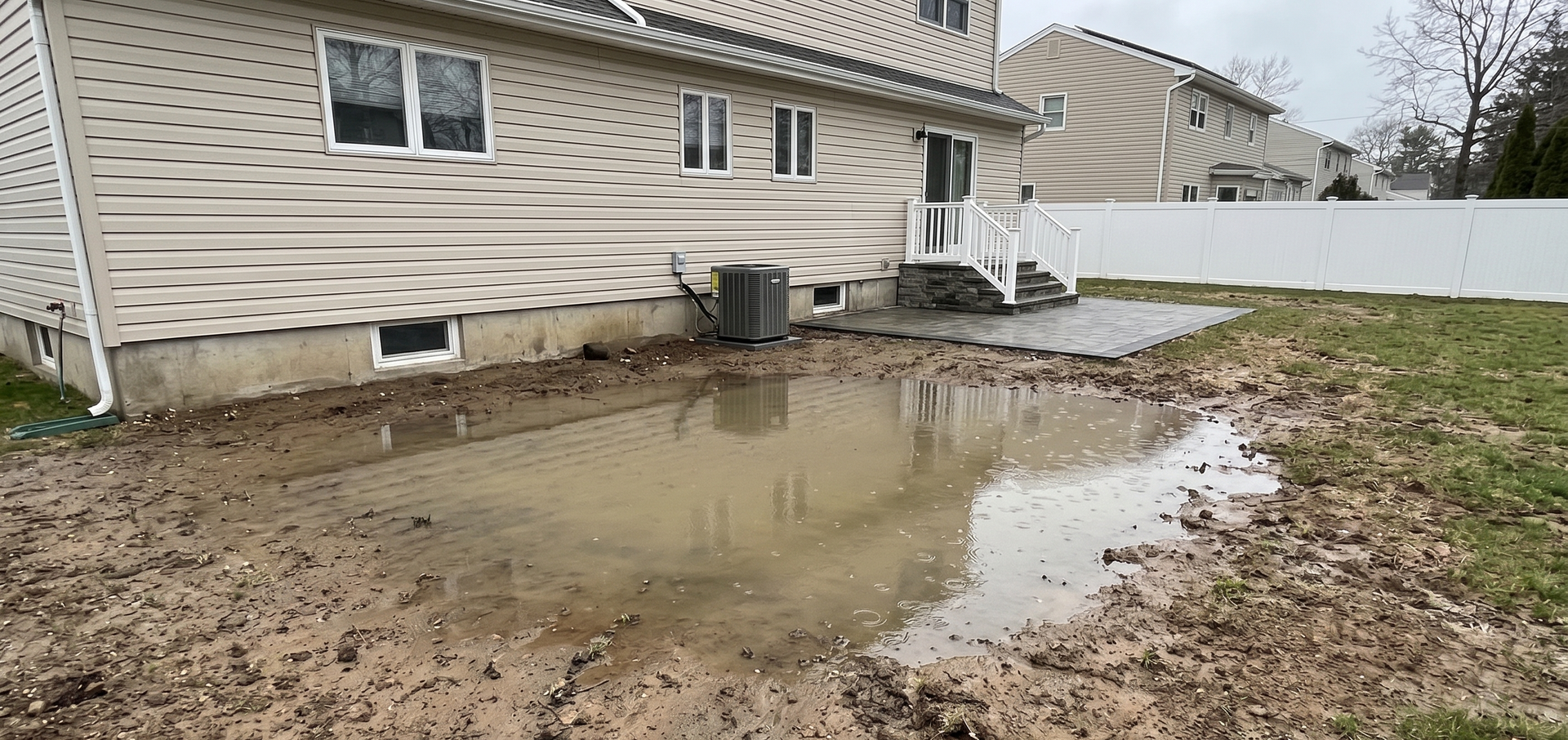
Basement moisture or seepage that surfaces after heavy rainfall almost always traces back to inadequate exterior drainage rather than a failure inside the home. A french drain installed along the foundation perimeter intercepts groundwater before it reaches the exterior wall, eliminating the hydrostatic pressure that drives moisture inward and addressing the source of the problem rather than where it shows up. Persistent wet areas in the yard — low spots that pool after every storm and take days to recover — are a direct indicator that natural drainage capacity has been exceeded. A french drain pulls that water into a managed subsurface system and routes it to a controlled outlet, restoring the yard's usability rather than leaving sections of it perpetually out of commission after rain. Homeowners who have built out patios, retaining walls, outdoor kitchens, or walkways have a direct stake in the drainage conditions those features depend on to stay structurally sound — water-saturated soil erodes the base beneath every one of them, and the cracking and settling that follows is both avoidable and expensive to repair after the fact.
For Syosset homeowners with any outdoor construction or renovation on the horizon, the most efficient time to incorporate drainage is during the project itself — before adjacent hardscape and plantings are in place around the trench path. The cost and disruption of coming back to add drainage after everything else is finished is consistently greater than building it in from the start.
Long-Term Value of Professional French Drain Installation in Syosset, NY
The value a well-installed french drain delivers accumulates quietly — not in anything that's visible immediately after the project, but in the pattern of what stops happening on the property over time. A foundation that holds dry through back-to-back wet seasons rather than showing new moisture every spring. A retaining wall that maintains its alignment through freeze and thaw cycles because the soil behind it has a drainage outlet. A patio that stays level across multiple years because the ground beneath it isn't being eroded by water with nowhere to go. These outcomes don't announce themselves the way a new outdoor kitchen or a freshly installed patio does — but the structural preservation and reduced repair costs they represent build genuine financial value across the life of the system.
That value registers in Syosset's competitive real estate market as well. Home inspections surface drainage problems consistently, and they're among the findings that most directly affect buyer confidence and transaction terms. A property where drainage has been professionally resolved — evidenced by a dry foundation, intact and level hardscaping, and a yard that handles Long Island weather without chronic saturation — communicates something clear about how the property has been managed over time. For Syosset homeowners who take both daily livability and long-term market position seriously, that combination makes french drain installation one of the more purposeful outdoor improvements available.
Get a Free French Drain Installation Estimate in
Syosset, NY
If drainage is affecting the condition or long-term value of your Syosset property, the cost of waiting grows with every storm that passes without a solution in place. JT Masonry & Landscaping offers free, on-site estimates for french drain installation across Nassau and Suffolk County, and Syosset is well within the communities we serve on a consistent basis. We'll come to your property, assess the drainage conditions directly, and develop a system designed around what your specific lot actually requires — not a standard approach applied without regard for the conditions we observe on the ground.
Call us at (516) 732-5133 or submit your estimate request online. We respond within 24 hours.