

French Drain Installation in Suffolk County, NY
Stop Water Damage Before It Starts — Professional Drainage Solutions for Suffolk County Homeowners
French Drain Installation on Long Island is one of the most dependable ways to protect your Suffolk County property from water damage, soil erosion around the foundation, and repeated flooding in the yard. At JT Masonry & Landscaping, we’ve spent over 15 years helping homeowners across Nassau and Suffolk County address drainage issues before they turn into larger and more expensive structural problems. In Suffolk County, where property conditions can vary from one neighborhood to the next but water problems can still build quickly, poor drainage often affects far more than just the lawn. Once water begins collecting without a proper path away from the property, it can contribute to saturated ground, cracked foundations, basement moisture, and damaged landscaping. A properly installed french drain redirects groundwater away from the parts of your property that need protection most, helping Suffolk County homeowners maintain a drier yard, a more secure foundation, and lasting peace of mind.

Contact JT Masonry and Landscaping!
Our team is ready to turn your vision into reality, creating stunning landscapes and enduring masonry structures.
Website Lead Form (Stone Veneers Page)

CLIENT REVIEWS
WHAT OUR CLIENTS ARE SAYING
JT Masonary and landscaping were exceptional right from the first point of contact to the completion of their work. The owner JUSTIN was very professional in the way he presented the work he was going to do. The workers were polite, efficient, and hard-working. And the results of their work was phenomenal! We are already considering them for another job. Thank you JUSTIN and Company.
We had a great experience with Justin and the crew at JT Masonry & Landscaping. We got a inground pool and pavers installed. They made it easy every step of the way from the planning stage to our first pool opening. We would definitely recommend this company to family and friends.


How French Drain Installation in Suffolk County Solves Your Property's Biggest Water Problems
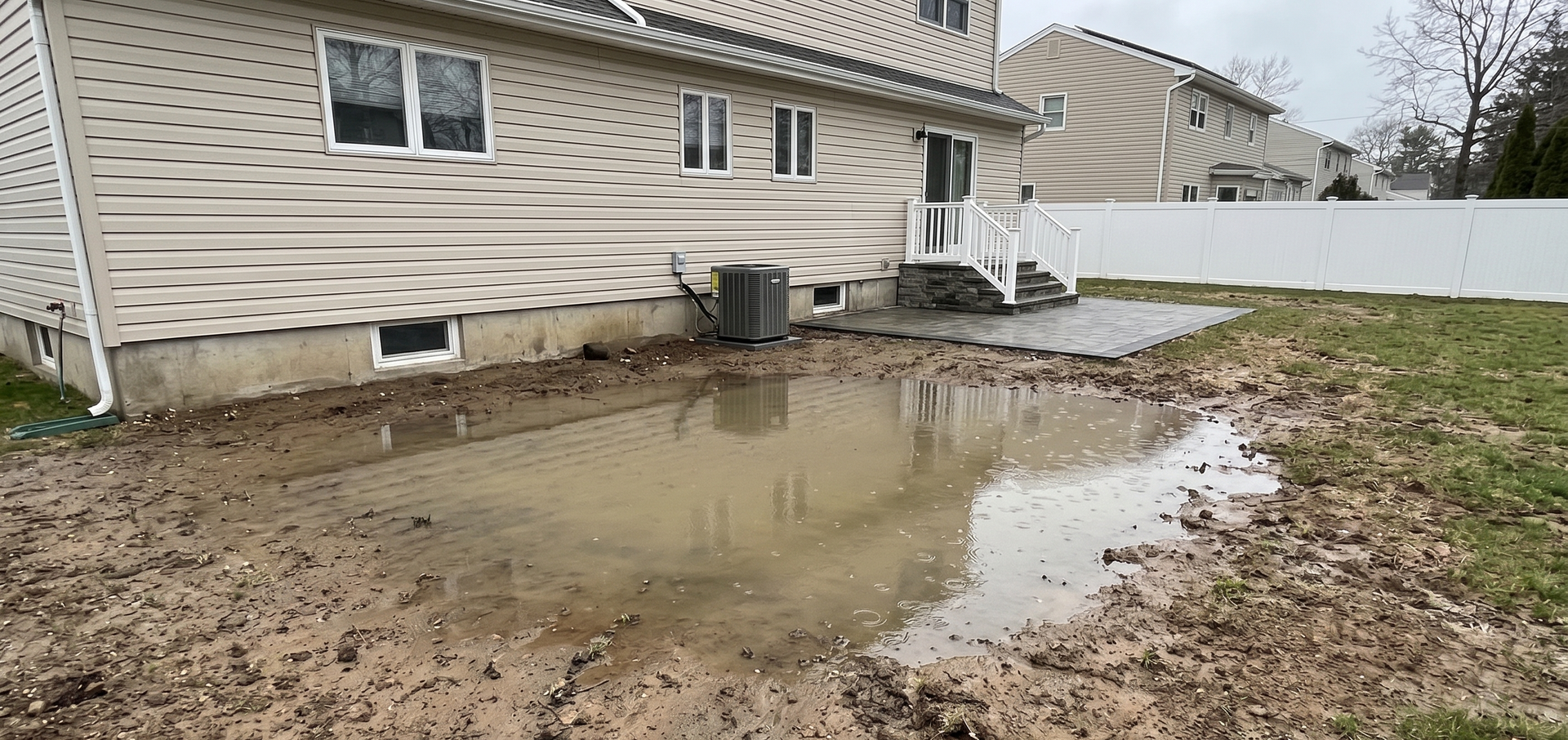
Across Suffolk County, drainage issues often start below the surface long before they become obvious. Long Island’s generally flat terrain, heavier soil conditions, and proximity to the water table can create the kind of environment where excess moisture lingers. If you’re seeing water pool in the yard after storms, dampness along basement walls, or low spots that stay muddy and wet for extended periods, poor subsurface drainage is usually the reason.
A french drain is an underground trench system that uses washed gravel and perforated piping to collect groundwater and carry it away from trouble areas — whether that’s your foundation, patio, retaining wall, or another low section of your Suffolk County property. Rather than providing a temporary surface fix, French Drain Installation on Long Island addresses the water issue where it begins: beneath the ground.
The result is more than just a yard that dries out faster. By reducing standing water around your Suffolk County home, you can also help prevent mold-related moisture problems, limit erosion that weakens hardscape features, and protect the value of the outdoor improvements you’ve made.
For beautiful walkways that stand the test of time, contact JT Masonry and Landscaping, schedule an appointment or call us at: (516) 732-5133
What Our French Drain Installation Process Looks Like
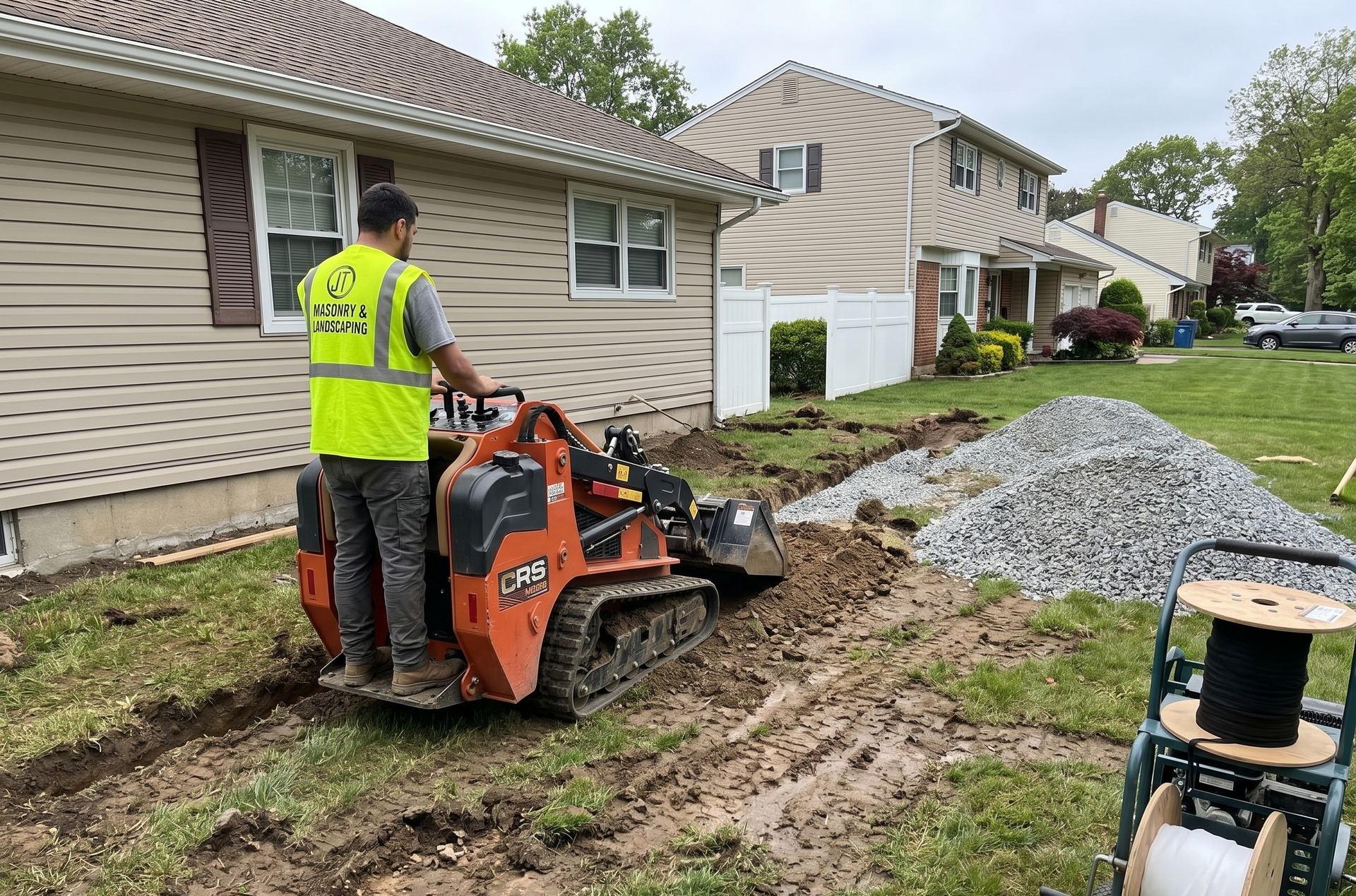
Every French Drain Installation on Long Island we perform at JT Masonry begins with a visit to the property. When working with homeowners in Suffolk County, we start by evaluating the slope, soil composition, and natural direction of water flow on the lot, because each property presents its own drainage challenges. After that, we design a system built around the specific needs of the site. Here’s what goes into a professional installation:
✔ Utility location and site preparation. Before excavation starts, underground utilities are identified and marked to help ensure the work can be completed safely.
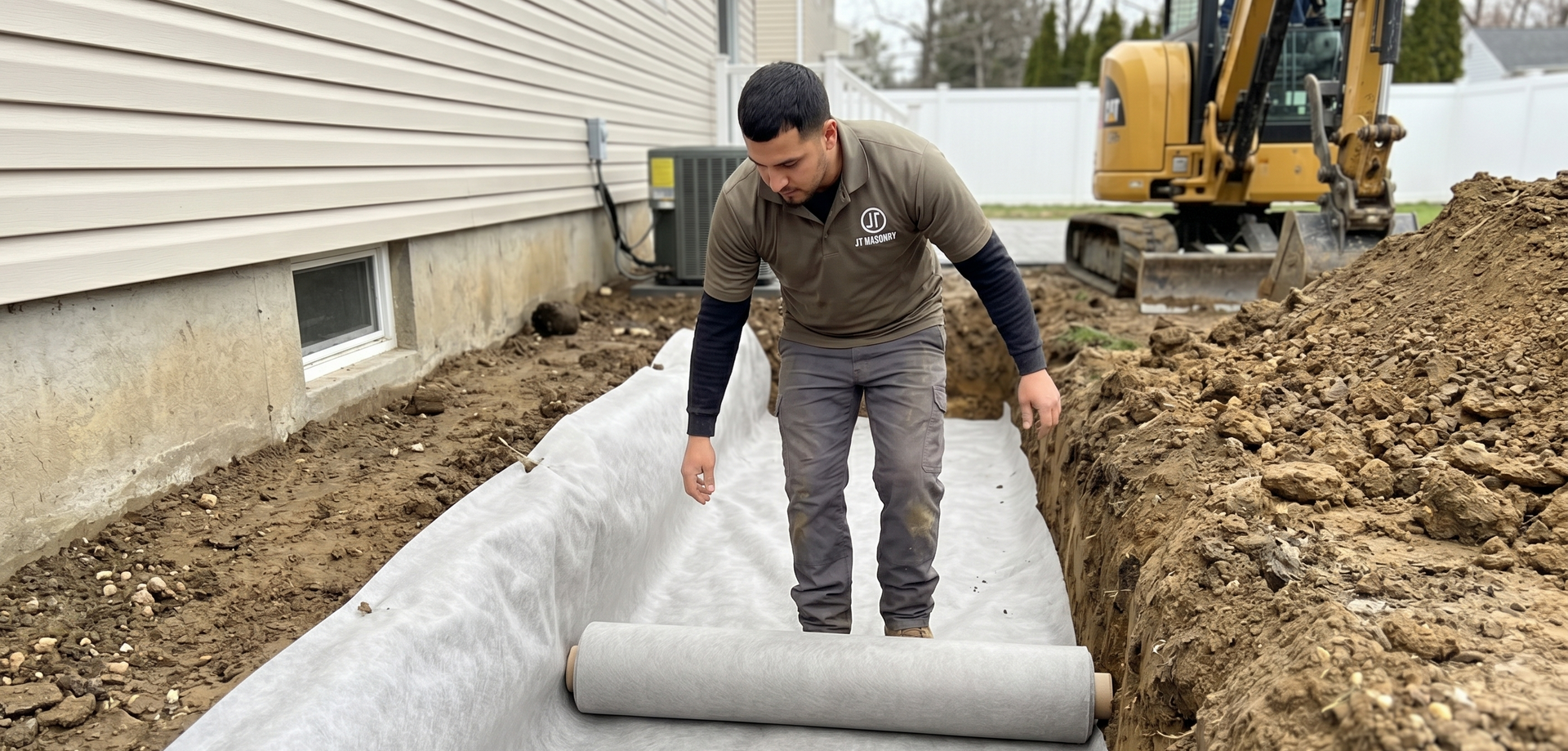
✔ Trench excavation along a calculated slope. The trench is excavated to the correct depth — typically 18 to 24 inches — and pitched at a minimum 1% slope, or about one inch of drop for every eight to ten feet, so water can move consistently toward the discharge point.
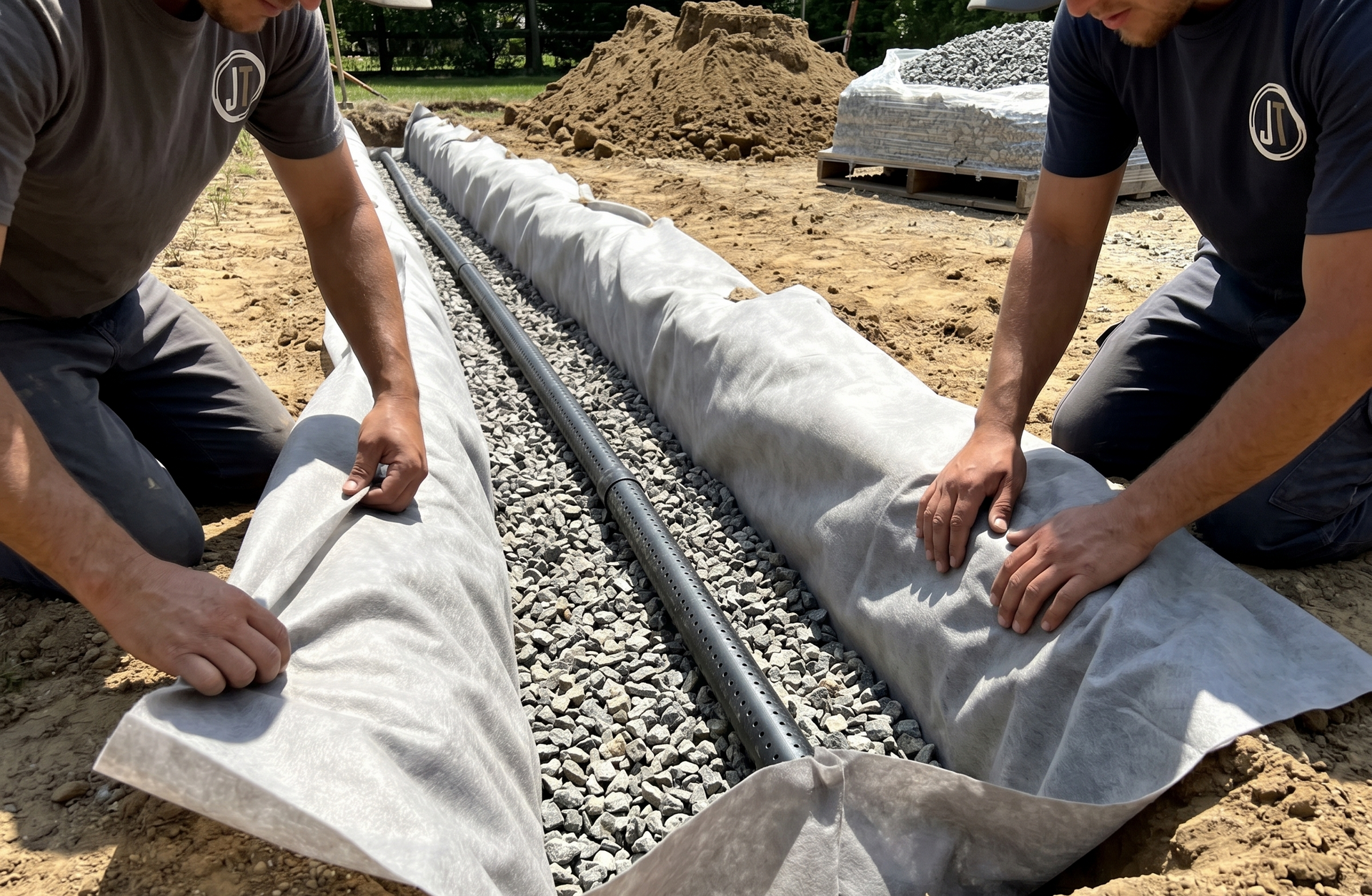
✔ Filter fabric lining. Nonwoven geotextile fabric is installed along the trench to help keep surrounding soil and fine sediment from entering the gravel bed and clogging the system over time. This step is essential to long-term performance.
✔ Gravel base and perforated pipe placement. A layer of washed gravel is installed before placing a rigid perforated pipe with the holes facing downward to improve groundwater collection. More gravel is then added around and over the pipe.
✔ Proper discharge routing. The final portion of the line transitions to solid piping that directs water to a safe discharge point, such as a dry well, drainage ditch, or pop-up emitter, away from your Suffolk County home and surrounding properties.
✔ Wrap, backfill, and restoration. The filter fabric is folded over the gravel layer, and the trench is then backfilled with soil and sod so the finished system is largely hidden once complete.
A successful system depends on more than just digging a trench and dropping in pipe. On a Suffolk County property, every installation detail — including trench pitch, material selection, and fabric placement — affects how well the drain performs over the long term.
Frequently Asked Questions About French Drain Installation in Suffolk County, NY
How long does a french drain installation take on a typical Long Island property?
The timeline for french drain installation depends on the length of the trench, the complexity of the routing, and the specific conditions of your property. Most residential installations on Long Island are completed within one to three days. During the initial consultation, JT Masonry provides a clear project timeline so you know exactly what to expect. We also coordinate around existing landscaping and hardscape features to minimize disruption to your yard during the process, and we leave the job site clean when the work is finished.
What type of pipe is used in a french drain?
Professional french drain installation typically uses rigid perforated PVC pipe or corrugated plastic pipe, usually 3.5 to 4 inches in diameter. At JT Masonry, the pipe selection is based on the volume of water the system needs to handle and the specific layout of your property. The perforated section of the pipe is installed with the holes facing downward, which allows groundwater to rise into the pipe from below rather than allowing soil sediment to fall in from above. The final section of the system transitions to solid pipe to carry collected water safely to the discharge point without any leakage along the way.
How much does french drain installation cost?
The cost of french drain installation varies based on several factors, including the total length of the trench, the depth required, soil conditions, accessibility of the work area, and the type of discharge point used. Because every Long Island property presents different challenges — from root systems and utility lines to soil composition and grade — we provide customized estimates rather than one-size-fits-all pricing. JT Masonry offers free on-site consultations where we evaluate your specific situation and provide a transparent, detailed estimate with no hidden fees. We also offer financing options to make drainage solutions accessible for homeowners.
Will a french drain damage my existing landscaping or hardscaping?
Some disruption to the yard surface is unavoidable during excavation, but a skilled installation crew minimizes the impact significantly. At JT Masonry, we carefully plan the trench route to avoid established plantings, irrigation lines, and hardscape features wherever possible. Once the french drain is installed and the trench is backfilled with soil and sod, the surface is restored and the system becomes virtually invisible. Our experience with both masonry and landscaping means we understand how to work around — and protect — the features you've already invested in, including patios, walkways, retaining walls, and pool areas.
How do I know if my property actually needs a french drain?
There are several reliable indicators that your property could benefit from french drain installation. Persistent standing water in your yard after rainstorms, damp or wet basement walls, efflorescence (white mineral deposits) on foundation surfaces, soggy or unusable sections of your lawn, and erosion around the base of your home or retaining walls are all signs that subsurface water isn't draining properly. If you've tried surface-level solutions like regrading or extending downspouts without lasting results, the problem is likely below the surface — which is exactly where a french drain operates. JT Masonry offers free property assessments to help you determine whether a french drain is the right solution for your specific drainage issue.ShareProject contentService Page Copy GeneratorCreated by youAdd PDFs, documents, or other text to reference in this project.
Why Suffolk County Homeowners Trust JT Masonry for French Drain Installation
The contractor you choose for French Drain Installation on Long Island can have a major impact on how well the system works and how long it lasts. Here’s why homeowners in Suffolk County continue to choose JT Masonry & Landscaping:
✔ Deep local knowledge. We understand how Long Island soil conditions, water table behavior, and municipal requirements affect drainage work across both Nassau and Suffolk County. That experience helps us create systems suited to the needs of Suffolk County properties.
✔ Full-service masonry and hardscape expertise. French drains often need to work alongside patios, retaining walls, pools, walkways, and other outdoor structures. Because we build those features too, we can plan drainage solutions that support the property as a whole.
✔ Owner-involved project management. From the initial consultation to the final walkthrough, you deal directly with the owner. That helps keep communication clear and the project moving smoothly.
✔ Licensed, insured, and detail-oriented. We carefully scope every project before installation begins so the work is well planned and surprises are minimized.
✔ Over 200 satisfied homeowners across Long Island. Homeowners throughout the region have trusted us with drainage, masonry, and outdoor construction projects, including service for properties in Suffolk County.
Can I Install My Own French Drain in Suffolk County?
While it may be technically possible to install a drainage system yourself, many DIY projects fall short because the details matter more than they initially seem. French Drain Installation on Long Island requires precise trench grading, proper pipe sizing, the right gravel, and correct filter fabric placement. If the slope is too shallow, water may not flow as intended and can remain trapped in the pipe. If the gravel is not appropriate, sediment can build up and clog the system. If the geotextile fabric is skipped or installed incorrectly, the life of the drain can be reduced significantly.
There is also the issue of buried utility lines. On Suffolk County properties, gas, electric, and water lines may be located at different depths, and striking one during excavation can be both dangerous and costly. Professional installation helps ensure that 811 utility locates are completed beforehand and that excavation is handled with care.
For Suffolk County homeowners who want a drainage solution that works properly from the beginning and continues performing for years, professional installation is the approach that provides real long-term value.
What Are the Downsides of a French Drain?
No drainage solution is completely without considerations, and Suffolk County homeowners should understand what French Drain Installation on Long Island involves before moving forward. The installation process requires excavation, which means part of the yard will be temporarily disturbed while the work is being completed. There is also a cost associated with having the system installed professionally. Still, when compared with the expense of foundation repair, basement waterproofing, or replacing damaged hardscaping, a french drain is often the far more cost-effective investment.
Even a properly installed system can lose some efficiency over time if the discharge point becomes blocked by debris or if root intrusion affects the pipe. That is why proper filter fabric installation and thoughtful discharge planning are so important from the start. With quality materials and professional workmanship, a french drain can continue protecting a Suffolk County property for many years, and routine checks of the outlet can help preserve performance.
The reality is that the disadvantages are minimal when compared with the cost of ignoring a drainage issue altogether — especially when unresolved water problems can lead to mold, structural damage, and reduced property value.
How Deep Should a French Drain Be Placed?
The ideal depth for French Drain Installation on Long Island depends on what the system is being designed to protect on your Suffolk County property. For standard yard drainage and surface water management, a trench depth of 18 to 24 inches is commonly used. That depth allows the perforated pipe to sit below the root zone and collect subsurface water effectively.
When a french drain is being installed to protect the foundation — often referred to as a footing drain — the trench may need to go deeper, sometimes extending to the level of the foundation footer. The trench is typically 9 to 12 inches wide, providing enough room for a gravel base, perforated pipe, and additional gravel fill.
At JT Masonry, we evaluate the specific drainage conditions of each Suffolk County property during the initial consultation to determine the proper depth and layout. Soil type, severity of the water issue, the drain’s location relative to the home, and the position of the discharge point all influence the final design. There is no single answer that works for every property, which is exactly why professional assessment matters.
Who Benefits Most from French Drain Installation in Suffolk County?
French Drain Installation on Long Island is not limited to one type of property — it’s a practical solution for many homeowners throughout Suffolk County. If any of the following situations sound familiar, a french drain may be exactly what your property needs:
Homeowners dealing with recurring basement moisture or flooding often find that a french drain installed around the exterior foundation perimeter helps solve the issue at its source. Suffolk County properties with flat yards or low-lying sections where water collects and remains after rainfall often benefit from a subsurface drainage system that carries water efficiently to a designated outlet. If you’ve invested in a patio, retaining wall, outdoor kitchen, or pool, a french drain helps protect that investment by reducing the saturation that can weaken the base beneath those structures and lead to shifting or cracking over time.
Even homeowners in Suffolk County who are planning new construction or outdoor renovation work can benefit from incorporating drainage into the project from the beginning, since it is usually easier and more cost-effective to install the system during construction than to retrofit it later.
Long-Term Value of Professional French Drain Installation in Suffolk County, NY
A properly installed french drain does more than fix the water issue you’re dealing with today. French Drain Installation on Long Island gives Suffolk County homeowners lasting protection that continues to add value after the job is complete. Your foundation stays better protected, your landscaping is more likely to remain intact, and your outdoor living spaces stay more usable even after heavy rain. Patios, retaining walls, and pool surrounds also benefit because the soil beneath them is less likely to be undermined by uncontrolled water movement.
There is also a clear impact on property value. Buyers and inspectors tend to notice drainage issues, but they also recognize when those concerns have already been professionally addressed. A well-designed french drain system is a meaningful improvement that adds both function and long-term value to your home.
Get a Free French Drain Installation Estimate in
Suffolk County, NY
If water is causing problems on your Suffolk County property, waiting usually gives those problems more time to get worse. JT Masonry & Landscaping provides free, on-site estimates for French Drain Installation on Long Island for homeowners across Nassau and Suffolk County. We’ll assess your property, explain your options, and design a drainage solution built to perform in Long Island’s unique conditions.
Call us at (516) 732-5133 or request your free estimate online. We respond within 24 hours.