

French Drain Installation in Oyster Bay, NY
Stop Water Damage Before It Starts — Professional Drainage Solutions for Oyster Bay Homeowners
Oyster Bay is one of Long Island's most historically significant communities — a North Shore harbor village where centuries of settlement have produced a landscape that ranges from waterfront estates and hillside properties to village-scale homes with histories that predate modern drainage infrastructure by generations. That character and history are part of what makes Oyster Bay distinctive. They're also part of what makes water management a more layered challenge here than in communities built during the post-war era with uniform lots and standardized construction. Harbor proximity influences the local water table. North Shore terrain creates grade transitions that move water in ways flat inland communities don't contend with. And older homes throughout the area were built long before subsurface drainage was part of the standard construction conversation. French drain installation on Long Island is how JT Masonry & Landscaping helps Oyster Bay homeowners address those challenges before they compound into structural problems. With over 15 years working across Nassau and Suffolk County, what we've seen holds true regardless of how old or how large a property is: water without a managed outlet finds one on its own, and the path it chooses is almost never the one that works in the homeowner's favor.

Contact JT Masonry and Landscaping!
Our team is ready to turn your vision into reality, creating stunning landscapes and enduring masonry structures.
Website Lead Form (Stone Veneers Page)

CLIENT REVIEWS
WHAT OUR CLIENTS ARE SAYING
JT Masonary and landscaping were exceptional right from the first point of contact to the completion of their work. The owner JUSTIN was very professional in the way he presented the work he was going to do. The workers were polite, efficient, and hard-working. And the results of their work was phenomenal! We are already considering them for another job. Thank you JUSTIN and Company.
We had a great experience with Justin and the crew at JT Masonry & Landscaping. We got a inground pool and pavers installed. They made it easy every step of the way from the planning stage to our first pool opening. We would definitely recommend this company to family and friends.


How French Drain Installation in Oyster Bay Solves Your Property's Biggest Water Problems
Oyster Bay's North Shore position introduces drainage dynamics that differ meaningfully from communities further inland or along the South Shore. The harbor's presence influences subsurface groundwater behavior in ways that aren't always apparent from the surface — particularly on properties within close proximity to the water, where the water table responds to seasonal and tidal conditions that keep the ground closer to saturation than it might appear. North Shore terrain adds another dimension: the grade transitions common to hillside and bluff-adjacent properties in this area accelerate water movement in ways that concentrate runoff at specific points — often at the base of slopes, along foundation walls, or at the edges of hardscape features that weren't designed to handle the volume directed toward them.
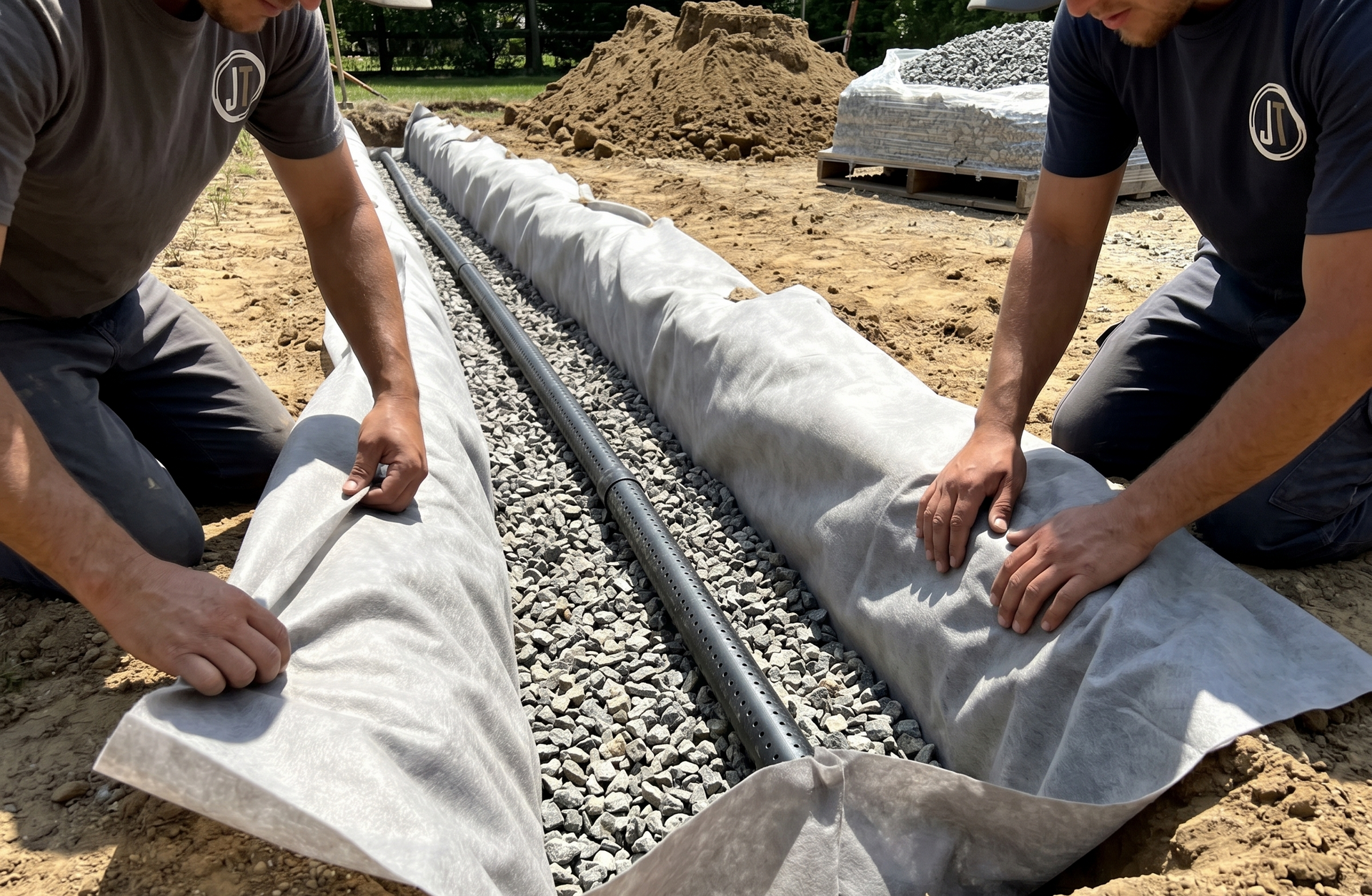
A french drain is engineered to intervene in that cycle before it reaches the damage stage. Installed below the surface, the system uses a perforated pipe housed within a gravel bed to capture subsurface water as it migrates and direct it toward a discharge point specifically chosen to protect the property's most vulnerable features. It doesn't redirect the problem — it removes it from the subsurface environment where structures and landscaping bear its consequences.
The effects are felt across every part of the property that water has been reaching. Foundations relieved of chronic hydrostatic pressure perform differently over time. Hardscape sitting over consistently drained soil maintains its level and structural integrity rather than shifting as the ground beneath it cycles through wet and dry extremes. And outdoor spaces that currently lose usability after significant rainfall reclaim their function across the full season rather than serving as temporary water collection areas after every storm.
For beautiful walkways that stand the test of time, contact JT Masonry and Landscaping, schedule an appointment or call us at: (516) 732-5133
What Our French Drain Installation Process Looks Like
The variety of lot configurations, terrain profiles, and construction histories across Oyster Bay means that drainage systems here have to be designed around the specific conditions present at each individual property — not adapted from a template that worked somewhere else. A harbor-adjacent property with significant grade change presents a fundamentally different drainage challenge than a village-scale lot on flat ground, and both differ from a hillside estate where multiple drainage problems may exist at different elevations on the same property. JT Masonry & Landscaping conducts a dedicated in-person site assessment at every property before any design is committed to, evaluating how water enters the lot, where it accumulates, what structures are at risk, and what discharge options the property can realistically support. The installation that follows covers every step that determines how the system performs over time:
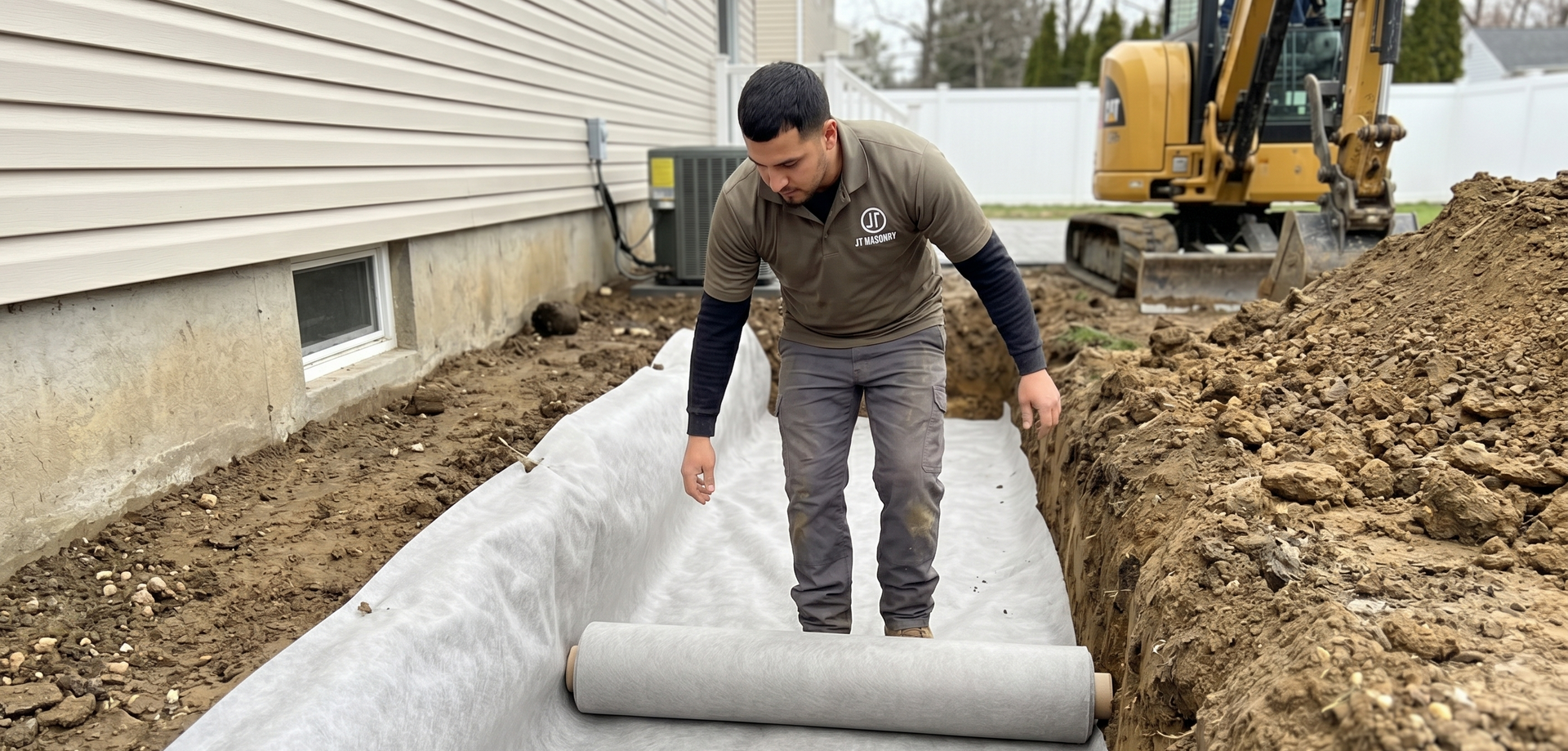
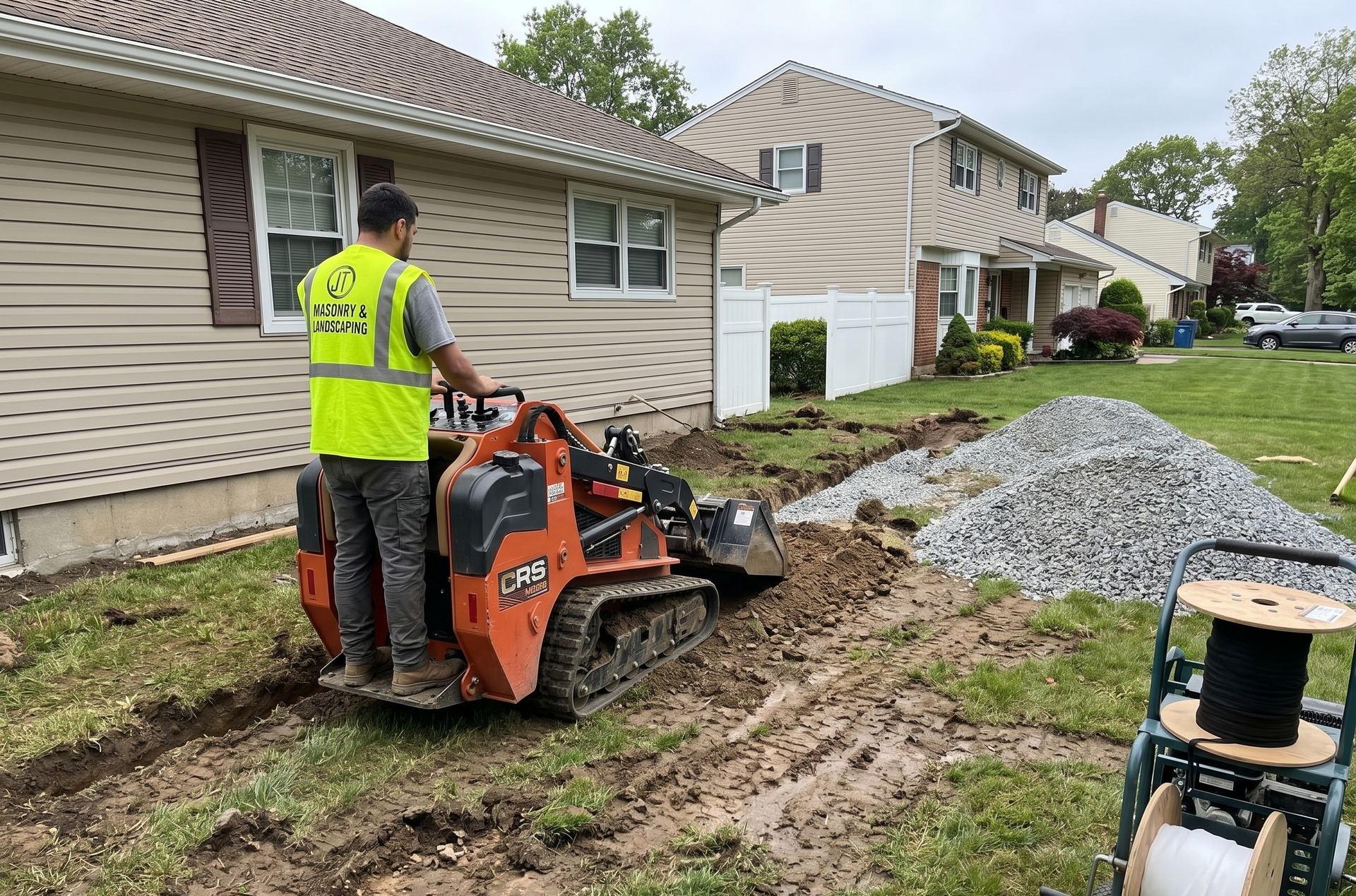
✔ An 811 utility locate is completed before excavation begins, with all underground lines — gas, electrical, water supply, and irrigation — identified and marked. On older Oyster Bay properties where utility infrastructure may have been installed across multiple eras and at varying depths, this step carries particular importance and is treated as a firm prerequisite on every project.
✔ The trench is cut to a working depth of 18 to 24 inches and graded to maintain a minimum 1% slope — one inch of fall per eight to ten feet of run — holding that pitch consistently across the full length of the system so water moves through the pipe toward the outlet rather than pooling inside it at any point along the run.
✔ Nonwoven geotextile fabric is laid throughout the full interior of the trench before gravel is introduced. This barrier prevents fine soil particles from migrating into the drainage bed over time — the mechanism responsible for the gradual capacity loss that affects systems where this step wasn't applied with full coverage and adequate care.
✔ Washed gravel establishes the drainage bed, followed by a rigid perforated pipe set with holes oriented downward to maximize water intake across the full length of the run. Gravel is then packed around and over the pipe to complete the assembly.
✔ As the system approaches the outlet, the perforated pipe transitions to solid piping that routes collected water to a designated discharge point — a dry well, pop-up emitter, or drainage ditch — positioned to remove water from the property without affecting neighboring lots or conflicting with local code requirements.
✔ The geotextile fabric is folded over the top of the gravel, the trench is backfilled with soil, and sod is restored over the surface. Once complete, the system is entirely invisible — what changes is how the property handles water after every significant storm.
The slope calculation, gravel specification, and fabric coverage are what determine whether this system is still performing correctly five and ten years from now. Those details are invisible once the ground is closed, but they're the variables everything else depends on.
Frequently Asked Questions About French Drain Installation in Oyster Bay, NY
How long does a french drain installation take on a typical Long Island property?
The timeline for french drain installation depends on the length of the trench, the complexity of the routing, and the specific conditions of your property. Most residential installations on Long Island are completed within one to three days. During the initial consultation, JT Masonry provides a clear project timeline so you know exactly what to expect. We also coordinate around existing landscaping and hardscape features to minimize disruption to your yard during the process, and we leave the job site clean when the work is finished.
What type of pipe is used in a french drain?
Professional french drain installation typically uses rigid perforated PVC pipe or corrugated plastic pipe, usually 3.5 to 4 inches in diameter. At JT Masonry, the pipe selection is based on the volume of water the system needs to handle and the specific layout of your property. The perforated section of the pipe is installed with the holes facing downward, which allows groundwater to rise into the pipe from below rather than allowing soil sediment to fall in from above. The final section of the system transitions to solid pipe to carry collected water safely to the discharge point without any leakage along the way.
How much does french drain installation cost?
The cost of french drain installation varies based on several factors, including the total length of the trench, the depth required, soil conditions, accessibility of the work area, and the type of discharge point used. Because every Long Island property presents different challenges — from root systems and utility lines to soil composition and grade — we provide customized estimates rather than one-size-fits-all pricing. JT Masonry offers free on-site consultations where we evaluate your specific situation and provide a transparent, detailed estimate with no hidden fees. We also offer financing options to make drainage solutions accessible for homeowners.
Will a french drain damage my existing landscaping or hardscaping?
Some disruption to the yard surface is unavoidable during excavation, but a skilled installation crew minimizes the impact significantly. At JT Masonry, we carefully plan the trench route to avoid established plantings, irrigation lines, and hardscape features wherever possible. Once the french drain is installed and the trench is backfilled with soil and sod, the surface is restored and the system becomes virtually invisible. Our experience with both masonry and landscaping means we understand how to work around — and protect — the features you've already invested in, including patios, walkways, retaining walls, and pool areas.
How do I know if my property actually needs a french drain?
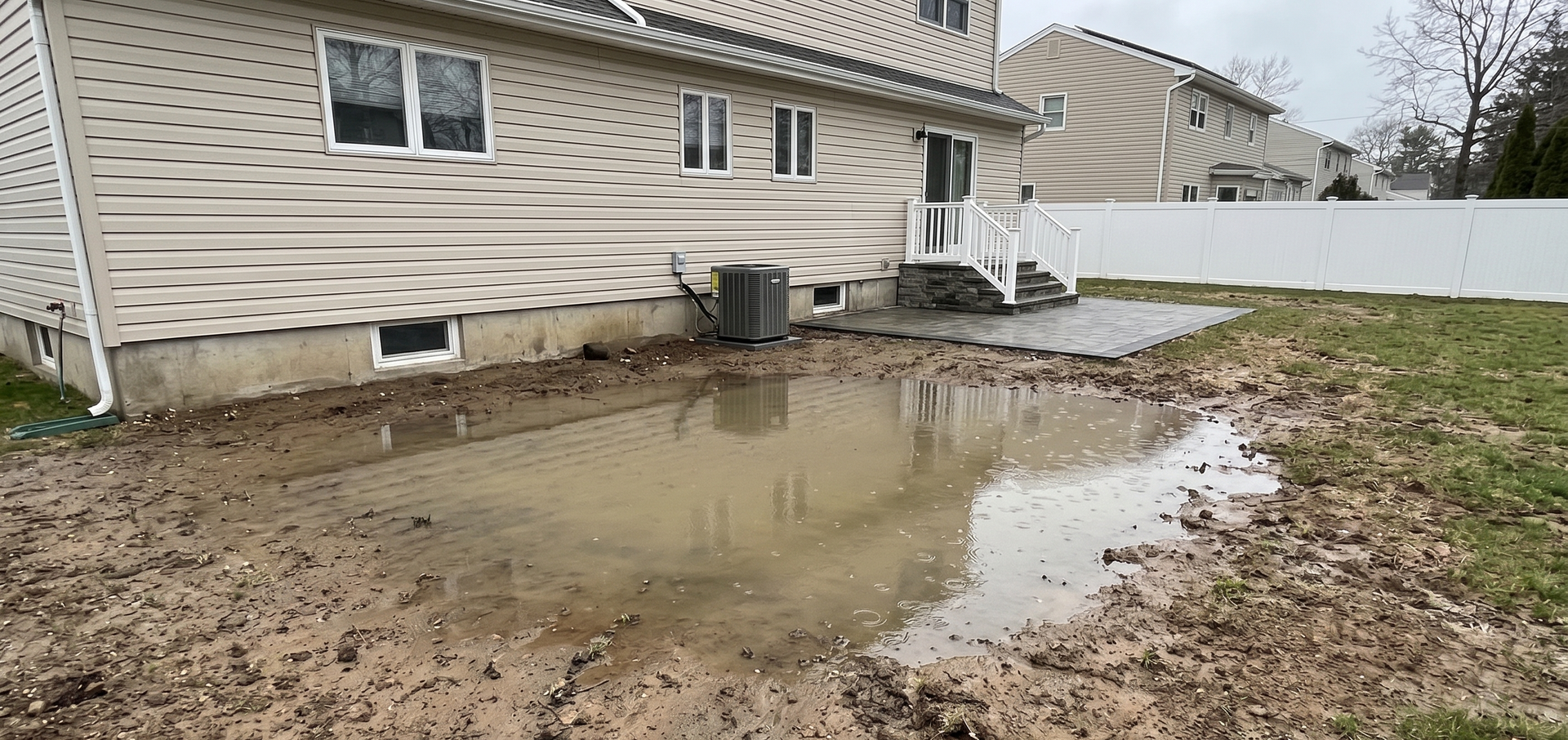
There are several reliable indicators that your property could benefit from french drain installation. Persistent standing water in your yard after rainstorms, damp or wet basement walls, efflorescence (white mineral deposits) on foundation surfaces, soggy or unusable sections of your lawn, and erosion around the base of your home or retaining walls are all signs that subsurface water isn't draining properly. If you've tried surface-level solutions like regrading or extending downspouts without lasting results, the problem is likely below the surface — which is exactly where a french drain operates. JT Masonry offers free property assessments to help you determine whether a french drain is the right solution for your specific drainage issue.ShareProject contentService Page Copy GeneratorCreated by youAdd PDFs, documents, or other text to reference in this project.
Why Oyster Bay Homeowners Trust JT Masonry for French Drain Installation
Oyster Bay properties reflect generations of investment — in the structures themselves, in the grounds surrounding them, and in the outdoor features that make them livable and valuable. Protecting that investment through drainage work requires a contractor with the regional knowledge and construction depth to design a system that functions as part of the complete property, not just as an isolated fix. What sets JT Masonry & Landscaping apart for Long Island homeowners who approach that decision seriously:
✔ 15 years of hands-on experience across Nassau and Suffolk County. Drainage on the North Shore involves soil profiles, groundwater behavior, and topographic conditions that differ from other parts of Long Island in ways that affect how systems need to be designed. That regional experience isn't transferable from other markets — it comes from sustained work here, across the full range of conditions Long Island presents.
✔ Masonry and hardscape expertise that informs how drainage is conceived. On a property with retaining walls, terraced landscaping, a pool surround, or a formal hardscape installation, drainage can't be designed in isolation from those features — they interact with how water moves across the lot in ways that have to be accounted for. Because JT Masonry builds those features directly, our drainage systems are planned with the full outdoor environment as the frame of reference.
✔ The owner is directly involved on every project from start to finish. From the initial site visit through the final inspection, you work with the owner — not a project manager serving as an intermediary. That continuity is how the details agreed on during the consultation become what actually gets built.
✔ Licensed, insured, and clear on scope before work begins. Every project is fully evaluated and priced upfront. Scope is defined, cost is transparent, and nothing gets added mid-project that wasn't part of the original conversation.
✔ A completed project portfolio of 200+ Long Island homeowners across drainage, masonry, and outdoor construction — a track record built on work that holds up over time and clients who refer neighbors without being prompted.
Can I Install My Own French Drain in Oyster Bay?
There's a version of french drain installation that looks complete from the outside and fails within a few seasons — and the difference between that outcome and a system that performs correctly for a decade comes down entirely to the precision applied during installation. Trench slope is the most frequently underestimated variable: the grade has to be held accurately and consistently from one end of the run to the other, because any section that falls short of the required pitch creates a low point where water collects rather than continues moving. A pipe with standing water inside it has stopped functioning as drainage. Gravel selection affects both how freely water enters the bed and the system's long-term resistance to the fine particle infiltration that reduces capacity gradually and invisibly over time. Filter fabric applied without full coverage or adequate overlap fails to protect the drainage bed in exactly the circumstances where that protection matters most. And pipe diameter undersized for the actual peak volume the system will handle performs adequately under light conditions but falls short when the system is most needed.
These failure patterns are predictable, and they show up regularly in installations where the work was approached without the precision the trade requires. In Oyster Bay, where North Shore terrain can concentrate water movement in ways that put more demand on a drainage system than a flat inland lot would, getting those variables right from the start matters considerably.
The utility consideration is equally relevant here. Oyster Bay's established residential and historic character means subsurface infrastructure — gas lines, water mains, electrical conduit, and irrigation systems — runs at varying depths that intersect directly with drainage excavation ranges, and on older properties, that infrastructure may have been installed across multiple generations without comprehensive documentation. Professional french drain installation on Long Island means the 811 locate is completed before any excavation begins, every line is identified, and the dig proceeds with a complete picture of what's underground. That process is the baseline standard on every project.
What Are the Downsides of a French Drain?
Approaching a french drain project with a realistic picture of what it involves leads to better planning and a more straightforward experience from start to finish. The installation requires excavation — that's unavoidable with any subsurface drainage system — and the section of the property above the trench run will be temporarily disrupted during the build. For Oyster Bay homeowners with established landscaping and outdoor environments that reflect significant investment, mapping out the restoration scope and timeline during the initial consultation is worth doing explicitly before work begins. Professional installation carries a cost, but that figure belongs in context: the foundation remediation, structural hardscape repair, and basement waterproofing that follow unresolved drainage problems are among the most disruptive and expensive interventions available to a homeowner, and they're routinely the consequence of conditions that were addressable far more economically at an earlier stage.
French drains built with quality materials and sound technique are designed to operate with minimal intervention over time, but the discharge outlet benefits from occasional attention across the system's lifespan. Debris accumulation at the outlet end and root intrusion near the pipe run are the most common sources of reduced flow in otherwise well-constructed systems — and both are straightforward to manage when the original pipe routing and fabric application were handled with care. Those decisions made at installation are precisely what keep long-term maintenance demands low and performance consistent year after year.
The trade-off at the center of this decision is straightforward regardless of the property: a defined upfront investment and a temporary disruption, against the structural and financial damage that compounds when water problems are left without a solution.
How Deep Should a French Drain Be Placed?
What depth a french drain needs to reach is established by what the system is being asked to accomplish at that specific property — not by selecting a standard figure and applying it uniformly across every project. For yard drainage and general subsurface water management, 18 to 24 inches is the working standard, placing the perforated pipe below the root zone and within the subsurface range where groundwater can be intercepted before it saturates the soil above. Foundation protection requires a different target: the trench has to reach the level of the foundation footer to cut off groundwater before hydrostatic pressure develops against the structure. Across Oyster Bay's varied property stock — which spans historic homes with construction configurations that differ substantially from mid-century and modern builds — foundation depths vary enough from property to property that those targets need to be established at each individual address rather than assumed. Trench width typically runs between 9 and 12 inches, providing adequate room for the gravel bed, pipe, and surrounding fill without creating more disruption to the surrounding landscape than the installation requires.
On North Shore properties throughout Oyster Bay, where terrain variation and harbor-adjacent groundwater conditions can introduce depth considerations beyond those encountered on flat inland lots, JT Masonry works through those specifics during the initial on-site consultation before any design decisions are finalized. Soil conditions, the severity and character of the water problem, the drain's position relative to the home's structure, and the discharge options the property can support all factor into the final design. Those variables combine differently on every property — which is precisely why depth and configuration decisions have to come from an assessment conducted at the lot itself.
Who Benefits Most from French Drain Installation in Oyster Bay?
French drain installation on Long Island addresses a wide range of property situations — and in a community like Oyster Bay, where North Shore terrain, harbor-influenced groundwater, and a broad range of home ages and construction types all contribute to how drainage problems develop, the scenarios that point toward a french drain span nearly every category of residential property:
Basement moisture or water infiltration that appears after significant rainfall is a consistent indicator that exterior subsurface drainage is failing to keep groundwater away from the structure. A french drain installed along the foundation perimeter intercepts that water before it reaches the wall, eliminating the hydrostatic pressure that drives moisture inward rather than treating its effects inside the home. Properties with grade transitions — hillside lots, bluff-adjacent parcels, or terraced landscaping where water accelerates downslope before collecting at a low point — are among the most direct applications for a french drain, which captures that migrating water below grade and routes it to a controlled outlet before it saturates the structures and plantings at the base of the slope. Homeowners who have invested in hardscape improvements — patios, retaining walls, pool surrounds, walkways, or outdoor living features — have a direct financial stake in the drainage conditions those features depend on to stay structurally sound. Water-saturated soil erodes the base beneath every one of them, and the cracking, shifting, and settling that follows is both avoidable and expensive to repair after the fact.
For any Oyster Bay homeowner with outdoor construction or a renovation project on the horizon, incorporating drainage during that window is consistently the most cost-effective and least disruptive approach. The alternative — retrofitting a drainage system after hardscape and landscaping are already in place — is a more complicated and more expensive project than building it in from the start.
Long-Term Value of Professional French Drain Installation in Oyster Bay, NY
The return a professionally installed french drain delivers accumulates in a way that doesn't produce a single visible moment of transformation — it produces a baseline shift in how the property behaves that compounds season after season. The foundation that holds dry through years of North Shore winters rather than developing the moisture infiltration that leads to structural compromise. The retaining wall that maintains its alignment through freeze and thaw cycles because the soil behind it has a functional drainage outlet rather than absorbing and holding water through every storm. The hardscape that stays level across multiple years because the ground beneath it isn't being undermined by water with no managed path away from the property. The yard that recovers from significant rainfall within hours rather than remaining waterlogged through the days that follow. None of these outcomes announces itself — but the structural preservation and reduced repair costs they represent build genuine and measurable value over the life of the system.
That value registers clearly in Oyster Bay's market as well. Buyers evaluating properties in this community bring a level of scrutiny that reflects the investment they're making, and drainage conditions — functional or otherwise — are among the findings that most directly shape both their assessment and their offer. A property where drainage has been professionally addressed carries a different profile than one where moisture in the basement or standing water in the yard remains a visible and unresolved issue. For Oyster Bay homeowners who take the long view on both daily livability and the position of their property in a competitive North Shore market, french drain installation is among the more purposeful outdoor improvements available.
Get a Free French Drain Installation Estimate in
Oyster Bay, NY
Oyster Bay homeowners dealing with yard flooding, foundation moisture, or drainage that isn't keeping pace with North Shore weather conditions don't have to keep absorbing the cost of a problem that has a clear and lasting solution. JT Masonry & Landscaping provides free, on-site estimates for french drain installation across Nassau and Suffolk County, and Oyster Bay is well within the communities we serve on a consistent basis. We'll visit your property, assess the drainage conditions directly — accounting for the terrain, groundwater behavior, and construction characteristics specific to this part of Long Island — and design a system built around what your specific lot actually requires.
Call us at (516) 732-5133 or submit your estimate request online. We respond within 24 hours.