

French Drain Installation in Jericho, NY
Stop Water Damage Before It Starts — Professional Drainage Solutions for Jericho Homeowners
Jericho carries the kind of reputation that takes decades to build — a hamlet in the Town of Oyster Bay where property values are high, homes are well-maintained, and outdoor environments reflect the kind of investment that homeowners in this community take seriously. What that reputation doesn't insulate properties from is what's happening beneath the surface. Jericho's inland position means its drainage challenges aren't driven by coastal proximity or tidal influence — they're driven by the same conditions that define drainage difficulty across much of Nassau County's interior: clay-dense soil that limits absorption, a water table with little room to accommodate additional moisture, and residential development that concentrates runoff onto ground that's already working near its percolation ceiling. French drain installation on Long Island is how JT Masonry & Landscaping helps Jericho homeowners protect the investments they've made in their properties before water finds a way to compromise them. Over 15 years of drainage work across Nassau and Suffolk County has produced the same observation consistently: the gap between a manageable drainage problem and a costly structural one closes faster than most homeowners anticipate — and a properly installed french drain is what keeps that gap from closing at all.

Contact JT Masonry and Landscaping!
Our team is ready to turn your vision into reality, creating stunning landscapes and enduring masonry structures.
Website Lead Form (Stone Veneers Page)

CLIENT REVIEWS
WHAT OUR CLIENTS ARE SAYING
JT Masonary and landscaping were exceptional right from the first point of contact to the completion of their work. The owner JUSTIN was very professional in the way he presented the work he was going to do. The workers were polite, efficient, and hard-working. And the results of their work was phenomenal! We are already considering them for another job. Thank you JUSTIN and Company.
We had a great experience with Justin and the crew at JT Masonry & Landscaping. We got a inground pool and pavers installed. They made it easy every step of the way from the planning stage to our first pool opening. We would definitely recommend this company to family and friends.


How French Drain Installation in Jericho Solves Your Property's Biggest Water Problems
Jericho's drainage conditions are shaped less by dramatic geography than by the quiet persistence of factors that compound over time. Clay soil throughout the Town of Oyster Bay area holds water rather than releasing it, which means that even moderate rainfall can push the ground toward saturation faster than it appears on the surface. Residential density adds to this — driveways, patios, and paved surfaces redirect water that would otherwise disperse across open ground onto the limited permeable areas that remain, increasing the volume the soil is asked to absorb with every storm. And because Jericho sits on relatively flat inland terrain with no natural grade advantage, that water tends to stay close to where it lands rather than moving toward any useful outlet on its own.
A french drain is built specifically for conditions where the ground's natural drainage capacity has been outpaced. The system runs below grade — a perforated pipe within a gravel-filled trench — intercepting groundwater before it has the opportunity to accumulate against vulnerable structures and routing it through a controlled path toward a discharge point safely removed from the home's foundation, hardscaping, and any low-lying section of the property prone to chronic saturation. The fix happens underground, not at the surface where the damage is already visible.
What follows from that intervention extends across the full property. Foundations no longer absorbing hydrostatic pressure from saturated soil hold up measurably better over time. Hardscape features built over consistently drained ground maintain their level and structural integrity instead of shifting through cycles of moisture and contraction. And basement conditions tied to exterior groundwater pressure are resolved at the source rather than managed symptom by symptom inside the home.
For beautiful walkways that stand the test of time, contact JT Masonry and Landscaping, schedule an appointment or call us at: (516) 732-5133
What Our French Drain Installation Process Looks Like
Jericho properties share a general geography, but drainage behavior varies from lot to lot in ways that make standardized solutions unreliable. How the grade sits between a home and its neighbors, where existing hardscape concentrates runoff, how mature landscaping affects water movement across the property, and what discharge options are realistically available all shape what a french drain system needs to look like to actually work. JT Masonry & Landscaping visits every property in person before any design is finalized — walking the lot, identifying where water enters and accumulates, and designing a system built around what that assessment reveals. Installation follows a defined sequence where each step carries direct accountability for long-term performance:
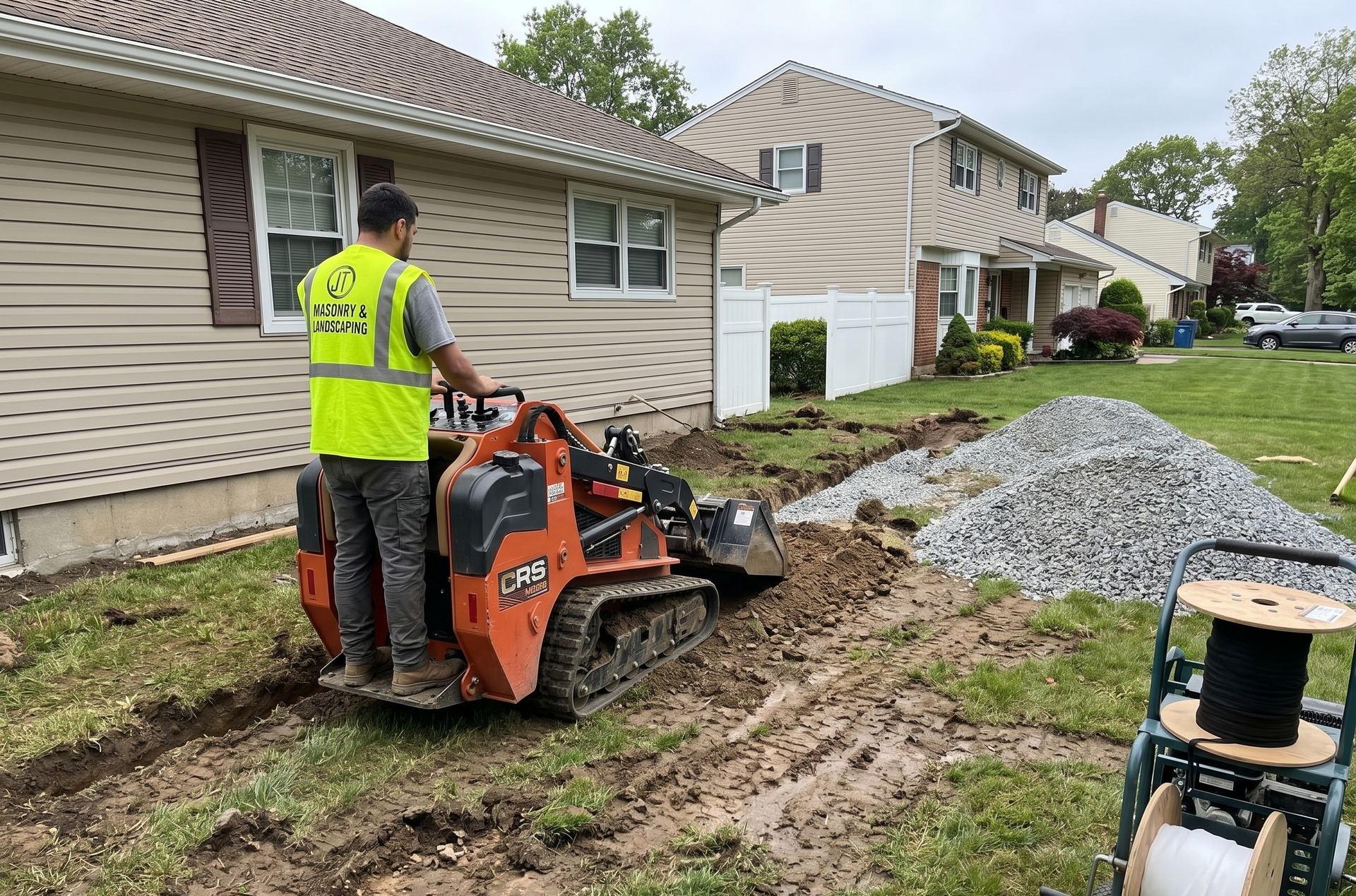
✔ An 811 utility locate is completed before any excavation begins, with all underground lines — gas, electrical, water supply, and irrigation — identified and marked. On a Jericho property with well-developed outdoor infrastructure, knowing what's underground before any digging starts is a non-negotiable first step on every project.
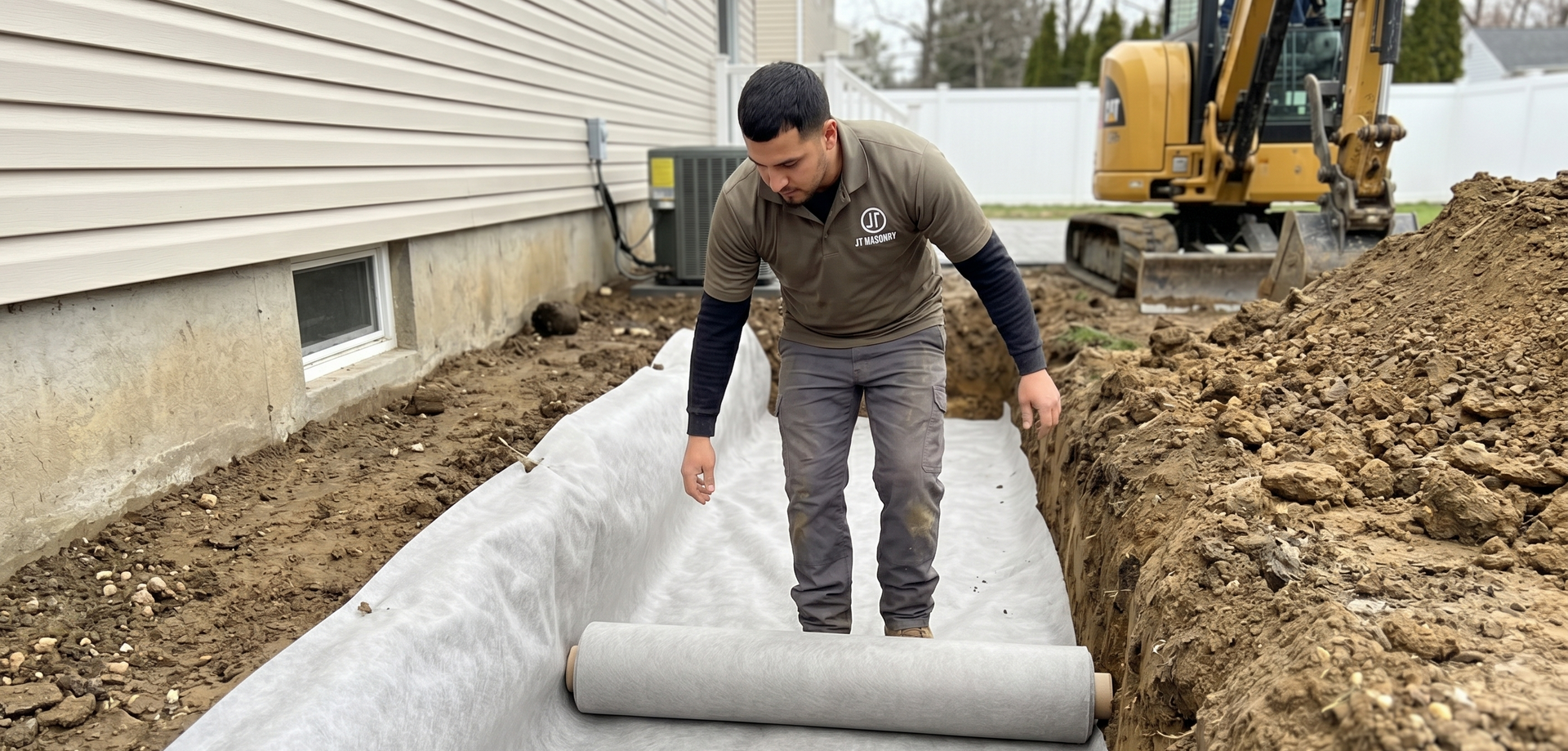
✔ The trench is excavated to a depth of 18 to 24 inches and graded at a minimum 1% slope — one inch of fall for every eight to ten feet of horizontal run — holding that pitch consistently across the full length of the system so water moves toward the outlet without stalling inside the pipe.
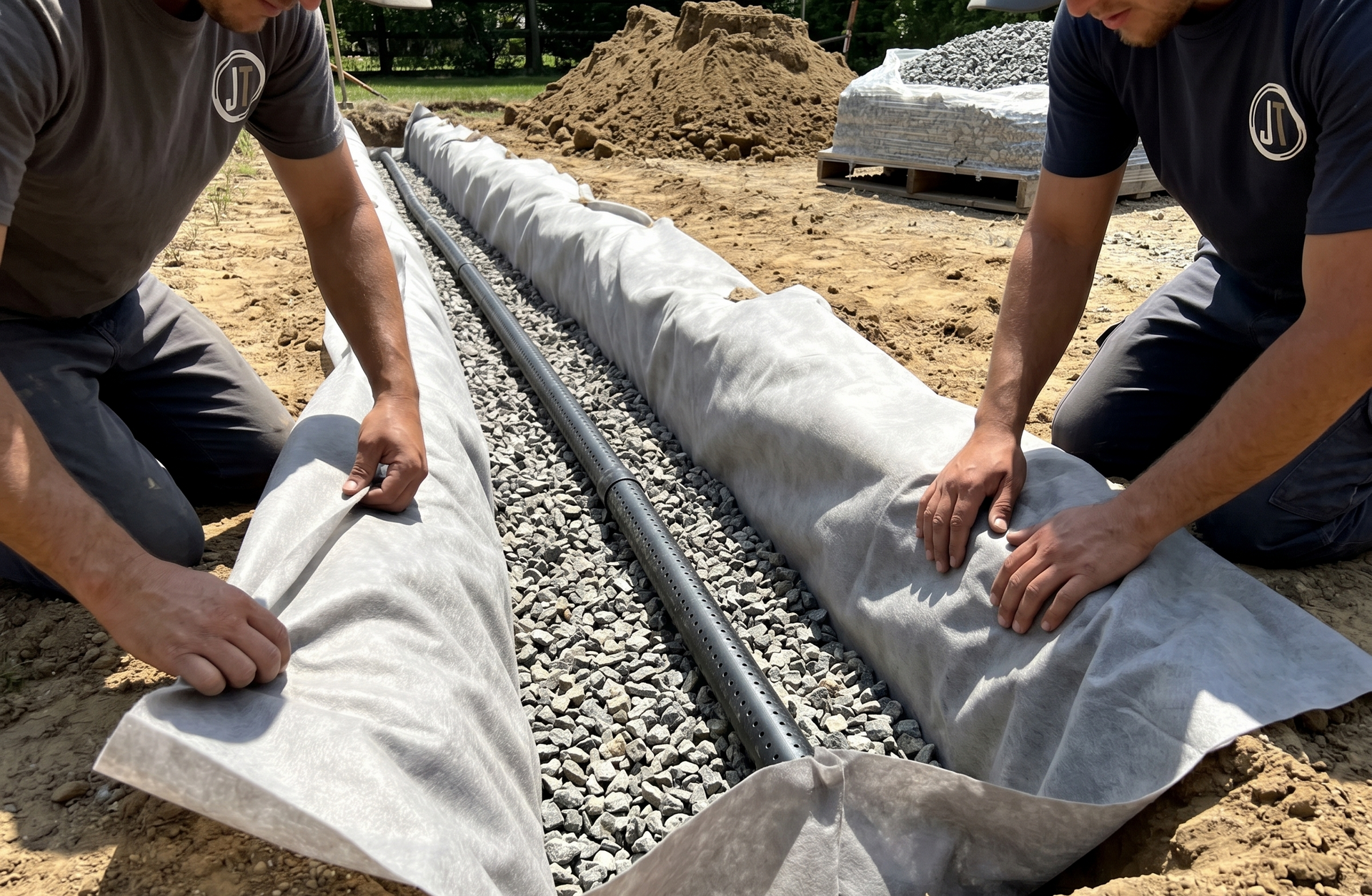
✔ Nonwoven geotextile fabric is installed throughout the full interior of the trench before any gravel is placed. This layer is what prevents fine soil and silt from infiltrating the drainage bed over time — the mechanism behind the gradual capacity loss that affects systems where this step was skipped or improperly applied.
✔ A layer of washed gravel establishes the drainage bed, followed by a rigid perforated pipe positioned with holes facing downward to draw water in across the full run. Additional gravel is packed around and over the pipe to complete the assembly and maintain the bed's structural integrity.
✔ Near the outlet end of the run, the perforated pipe transitions to solid piping that carries collected water to a designated discharge point — a dry well, pop-up emitter, or drainage ditch — selected based on the property's configuration and applicable local requirements.
✔ The geotextile fabric is folded over the top of the gravel bed, the trench is backfilled with soil, and the surface is restored with sod. Once finished, the system is completely out of sight — the only indication it's there is a yard that behaves differently after rain than it did before.
The slope, gravel specification, and fabric installation are what determine whether this system is still performing correctly in five years or whether it's already showing signs of the degradation that comes from skipping those details.
Frequently Asked Questions About French Drain Installation in Jericho, NY
How long does a french drain installation take on a typical Long Island property?
The timeline for french drain installation depends on the length of the trench, the complexity of the routing, and the specific conditions of your property. Most residential installations on Long Island are completed within one to three days. During the initial consultation, JT Masonry provides a clear project timeline so you know exactly what to expect. We also coordinate around existing landscaping and hardscape features to minimize disruption to your yard during the process, and we leave the job site clean when the work is finished.
What type of pipe is used in a french drain?
Professional french drain installation typically uses rigid perforated PVC pipe or corrugated plastic pipe, usually 3.5 to 4 inches in diameter. At JT Masonry, the pipe selection is based on the volume of water the system needs to handle and the specific layout of your property. The perforated section of the pipe is installed with the holes facing downward, which allows groundwater to rise into the pipe from below rather than allowing soil sediment to fall in from above. The final section of the system transitions to solid pipe to carry collected water safely to the discharge point without any leakage along the way.
How much does french drain installation cost?
The cost of french drain installation varies based on several factors, including the total length of the trench, the depth required, soil conditions, accessibility of the work area, and the type of discharge point used. Because every Long Island property presents different challenges — from root systems and utility lines to soil composition and grade — we provide customized estimates rather than one-size-fits-all pricing. JT Masonry offers free on-site consultations where we evaluate your specific situation and provide a transparent, detailed estimate with no hidden fees. We also offer financing options to make drainage solutions accessible for homeowners.
Will a french drain damage my existing landscaping or hardscaping?
Some disruption to the yard surface is unavoidable during excavation, but a skilled installation crew minimizes the impact significantly. At JT Masonry, we carefully plan the trench route to avoid established plantings, irrigation lines, and hardscape features wherever possible. Once the french drain is installed and the trench is backfilled with soil and sod, the surface is restored and the system becomes virtually invisible. Our experience with both masonry and landscaping means we understand how to work around — and protect — the features you've already invested in, including patios, walkways, retaining walls, and pool areas.
How do I know if my property actually needs a french drain?
There are several reliable indicators that your property could benefit from french drain installation. Persistent standing water in your yard after rainstorms, damp or wet basement walls, efflorescence (white mineral deposits) on foundation surfaces, soggy or unusable sections of your lawn, and erosion around the base of your home or retaining walls are all signs that subsurface water isn't draining properly. If you've tried surface-level solutions like regrading or extending downspouts without lasting results, the problem is likely below the surface — which is exactly where a french drain operates. JT Masonry offers free property assessments to help you determine whether a french drain is the right solution for your specific drainage issue.ShareProject contentService Page Copy GeneratorCreated by youAdd PDFs, documents, or other text to reference in this project.
Why Jericho Homeowners Trust JT Masonry for French Drain Installation
For Jericho homeowners managing properties where outdoor features, mature landscaping, and structural investments are all part of the picture, the contractor behind a french drain installation is as important as the installation itself. What consistently distinguishes JT Masonry & Landscaping for Long Island homeowners who take that selection seriously:
✔ 15 years of experience specific to Nassau and Suffolk County. Drainage conditions across Long Island's interior communities — including Jericho's Town of Oyster Bay location — involve soil profiles, water table behavior, and code requirements that don't translate from other regions. That knowledge only comes from sustained work here, and it shapes every decision we make on site.
✔ Outdoor construction capabilities that give drainage design its proper context. Retaining walls hold back soil that carries subsurface water pressure. Patios channel runoff toward the edges of the lot. Driveways redirect significant volumes of storm water onto adjacent ground. Because JT Masonry designs and builds those features, our drainage solutions are conceived with the full outdoor environment in mind rather than addressing the drainage problem in isolation from everything surrounding it.
✔ The owner is personally involved on every project. From the first consultation through the final walkthrough, you work directly with the owner — not a coordinator managing the project at a remove. That direct involvement is how what was agreed on in the assessment becomes what actually gets installed.
✔ Licensed, insured, and transparent on scope before any work begins. Every project is evaluated and priced in full upfront. The scope is defined clearly, the cost is known before the first shovel enters the ground, and nothing gets added mid-project without prior discussion.
✔ A track record of 200+ completed Long Island projects across drainage, masonry, and outdoor construction — built on results that hold up over time and clients who return for the next project.
Can I Install My Own French Drain in Jericho?
French drain installation is one of those trades where the margin between a system that performs for a decade and one that fails within a season is entirely a function of how precisely the work was done. Slope is the most consequential variable: the trench grade has to be held accurately from one end of the run to the other, because any section that falls short of the minimum pitch creates a collection point inside the pipe. A pipe accumulating standing water isn't a drainage system — it's a buried obstruction. Gravel specification determines both the rate at which water enters the drainage bed and the system's long-term resistance to sediment infiltration, which degrades capacity gradually and without any visible indication until performance is already significantly reduced. Pipe sizing has to account for the actual volume of water the system will handle during significant storm events, not just average conditions. And filter fabric that isn't installed with complete coverage and proper overlap leaves the gravel bed exposed to the fine particle migration that shortens the system's effective lifespan.
These aren't uncommon failure points — they're the predictable result of approaching the work without the precision it requires. In Jericho, where clay soil means the drainage system is already working against natural percolation limitations from the moment it goes in the ground, those failure modes tend to surface faster than they would on a more permeable site.
Beyond the technical variables, there's the utility reality that applies to any established Nassau County community. Gas lines, water mains, electrical conduit, and irrigation infrastructure run at depths throughout Jericho's residential streets that fall directly within drainage excavation range. Professional french drain installation on Long Island means the 811 locate is completed and every underground line is documented before excavation begins — not as a formality, but as the step that shapes how the entire dig is planned. That standard applies on every project without exception.
What Are the Downsides of a French Drain?
Knowing what french drain installation actually involves before committing to it sets the project up for better planning and fewer surprises along the way. Excavation is inherent to the work — a defined section of the yard will be temporarily out of use while the system is being installed, and that disruption is worth mapping out during the initial consultation so its scope and timeline are understood clearly before anything begins. For Jericho homeowners who've invested in their outdoor environments, the restoration component is worth discussing specifically — how the surface will be left after installation and what, if any, additional landscaping will be needed to return the area to its previous condition. The cost of professional installation is real, but it belongs alongside an honest accounting of the alternative: foundation remediation, hardscape reconstruction, and basement waterproofing are among the most disruptive and expensive repairs a homeowner can face, and they're routinely the result of drainage problems that were correctable far more economically before the damage compounded to that point.
Properly installed french drains are low-maintenance systems over their lifespan, but the discharge outlet benefits from periodic inspection. Debris accumulation and root intrusion near the outlet end are the most common sources of flow reduction in systems that were otherwise built correctly, and both are straightforward to manage when the pipe routing and fabric installation were done thoughtfully from the start. The care applied to those decisions during installation is what keeps long-term maintenance demands minimal and the system running at capacity year after year.
The comparison at the center of this decision doesn't change regardless of the property: a defined upfront investment and a temporary disruption, against the compounding structural and financial cost of a drainage problem left to run its course.
How Deep Should a French Drain Be Placed?
The correct depth for a french drain is a function of what the system is designed to accomplish — not a fixed number applied uniformly across every property or every drainage problem. Yard drainage and subsurface water management call for a trench depth of 18 to 24 inches, positioning the perforated pipe below the root zone where it can intercept groundwater before saturation builds toward the surface. When foundation protection is the objective, the calculus changes: the trench needs to reach the depth of the foundation footer, cutting off water before hydrostatic pressure can develop against the structure. Across Jericho's residential properties — which span a range of construction periods and foundation configurations — that target depth isn't consistent from one home to the next and needs to be established at each address specifically rather than assumed in advance. Trench width typically falls between 9 and 12 inches, providing enough space for the gravel bed, pipe assembly, and surrounding fill without requiring more disruption to the surrounding landscape than the installation demands.
For Jericho properties, JT Masonry works through depth and configuration questions during the initial on-site consultation before any design commitments are made. Soil composition at the specific location, the nature and pattern of the drainage problem, the intended position of the drain relative to the home's foundation, and the discharge options the lot can realistically support all factor into what the final design looks like. Those variables combine differently on every property — which is why the right depth and configuration have to come from an assessment conducted at the lot itself, not from a specification selected before the ground has been evaluated.
Who Benefits Most from French Drain Installation in Jericho?
French drain installation on Long Island is a solution that fits a wide range of drainage situations — and in a community like Jericho, where clay soil, inland terrain, and established residential development combine to limit how much water the ground can handle, the circumstances that call for one arise more frequently than many homeowners expect:
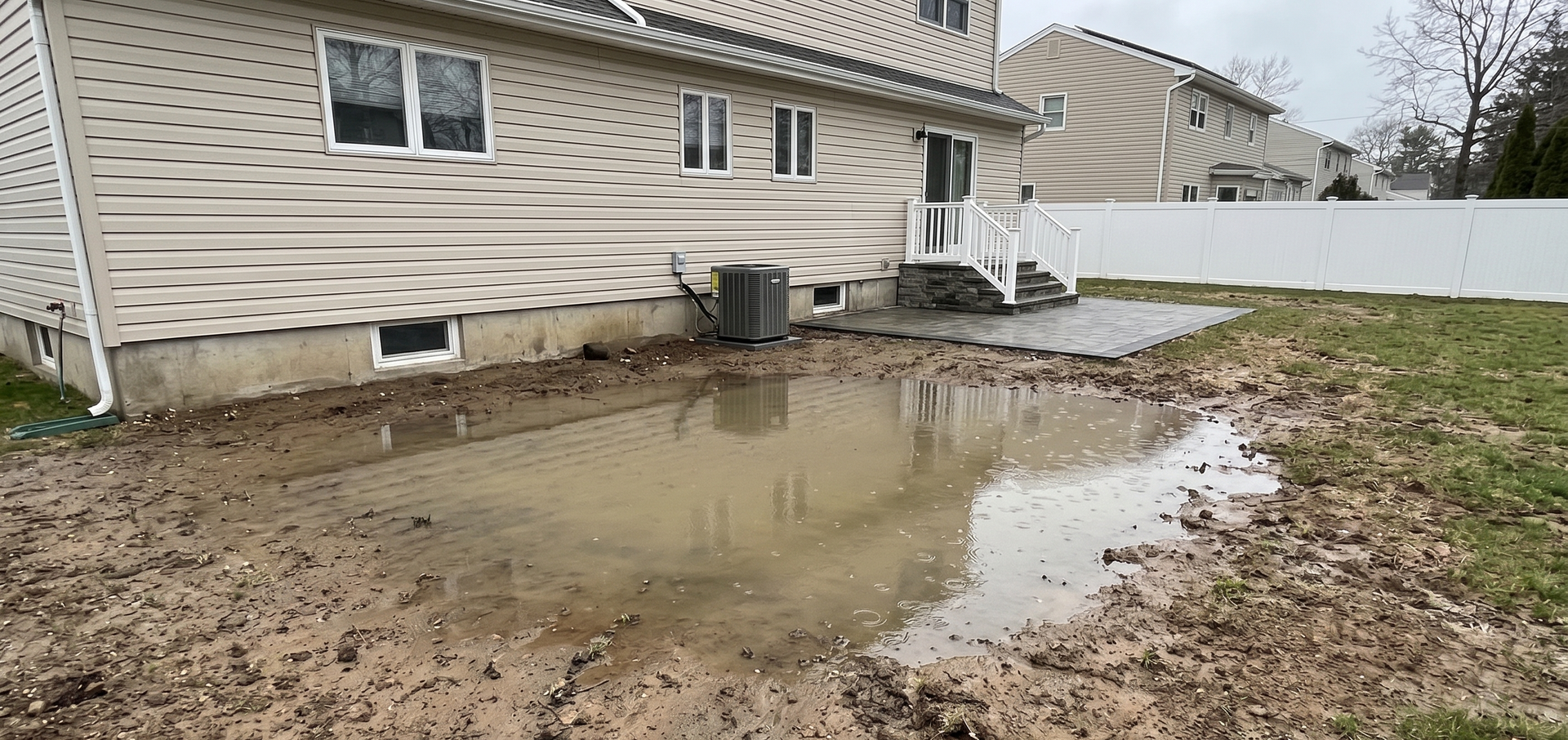
Basement moisture or seepage that materializes reliably after heavy rain is one of the clearest indicators that groundwater is accumulating against the foundation exterior due to inadequate subsurface drainage. A french drain installed along the foundation perimeter captures that water before it reaches the structure, removing the pressure that drives moisture inward rather than addressing what it produces inside the home. Sections of the yard that pool after storms and take multiple days to recover — or that never seem to fully dry out between rain events — signal that the ground's drainage capacity has been exceeded. A french drain draws that water into a managed subsurface system and routes it to a controlled outlet, restoring the yard's usability and protecting the plantings and turf that chronic saturation gradually destroys. For homeowners who have developed their outdoor spaces with patios, retaining walls, walkways, outdoor kitchens, or other hardscape improvements, drainage is the foundational infrastructure those features depend on to remain structurally sound — water-saturated soil erodes what's beneath them, and the settling, cracking, and movement that results turns finished improvements into repair projects.
Any Jericho homeowner planning outdoor construction or a property renovation is also in the best position to address drainage during that window. The disruption and cost of incorporating a french drain alongside active work is meaningfully lower than returning to add it after everything else is finished around it.
Long-Term Value of Professional French Drain Installation in Jericho, NY
The return on a professionally installed french drain doesn't present itself in a single visible outcome — it shows up steadily, across every season that follows, in the form of structural problems that don't develop and repair costs that don't materialize. A foundation that remains dry through a run of wet winters rather than accumulating the hairline cracks that grow expensive over time. A patio that holds its level across multiple years because the soil beneath it is draining consistently rather than eroding under unmanaged water movement. Retaining walls that maintain their alignment through the freeze and thaw cycles that test every Long Island property each year. A yard that recovers from significant rainfall in hours rather than remaining saturated for the better part of the week that follows. These aren't dramatic improvements — they're the quiet, compounding benefit of having removed a problem that would otherwise have kept growing.
In Jericho's real estate environment, where buyers conducting due diligence are thorough and property values give them reason to be, drainage issues are among the findings that most directly affect both buyer perception and transaction terms. A property where drainage has been professionally addressed — where the foundation is dry, hardscaping is intact and level, and the yard handles Long Island weather without chronic saturation — signals something meaningful about how the property has been managed. For Jericho homeowners who value both the day-to-day quality of their property and where it stands in the market over the long term, french drain installation is one of the more purposeful and enduring improvements available.
Get a Free French Drain Installation Estimate in
Jericho, NY
If water is affecting the condition, function, or long-term value of your Jericho property, each storm that passes without a solution in place represents a cost that adds to the next one. JT Masonry & Landscaping provides free, on-site estimates for french drain installation across Nassau and Suffolk County, and Jericho is well within the communities we serve on a regular basis. We'll come to your property, evaluate the specific drainage conditions firsthand, and build a system designed around what your lot actually requires — informed by what we observe on the ground, not by assumptions made at a distance.
Call us at (516) 732-5133 or submit your estimate request online. We respond within 24 hours.