

French Drain Installation in Hicksville, NY
Stop Water Damage Before It Starts — Professional Drainage Solutions for Hicksville Homeowners
Hicksville is one of Nassau County's most established suburban communities — densely developed, built largely on post-war residential stock, and home to the kind of smaller lots where drainage problems don't just affect one corner of the yard but can compromise the entire property. When houses sit close together, impervious surfaces are plentiful, and every neighboring lot sheds water in the same direction, the ground reaches its absorption limit quickly. French drain installation on Long Island is one of the most dependable solutions available for homeowners in this situation, and JT Masonry & Landscaping has been delivering that solution across Nassau and Suffolk County for over 15 years. The lesson this region has reinforced consistently: water accumulating without a managed outlet doesn't wait for a convenient time to cause damage. Flooded basements, foundation erosion, deteriorating hardscape, and chronically saturated yards are the predictable result — and a professionally installed french drain is what interrupts that progression before the repair bills arrive.

Contact JT Masonry and Landscaping!
Our team is ready to turn your vision into reality, creating stunning landscapes and enduring masonry structures.
Website Lead Form (Stone Veneers Page)

CLIENT REVIEWS
WHAT OUR CLIENTS ARE SAYING
JT Masonary and landscaping were exceptional right from the first point of contact to the completion of their work. The owner JUSTIN was very professional in the way he presented the work he was going to do. The workers were polite, efficient, and hard-working. And the results of their work was phenomenal! We are already considering them for another job. Thank you JUSTIN and Company.
We had a great experience with Justin and the crew at JT Masonry & Landscaping. We got a inground pool and pavers installed. They made it easy every step of the way from the planning stage to our first pool opening. We would definitely recommend this company to family and friends.


How French Drain Installation in Hicksville Solves Your Property's Biggest Water Problems
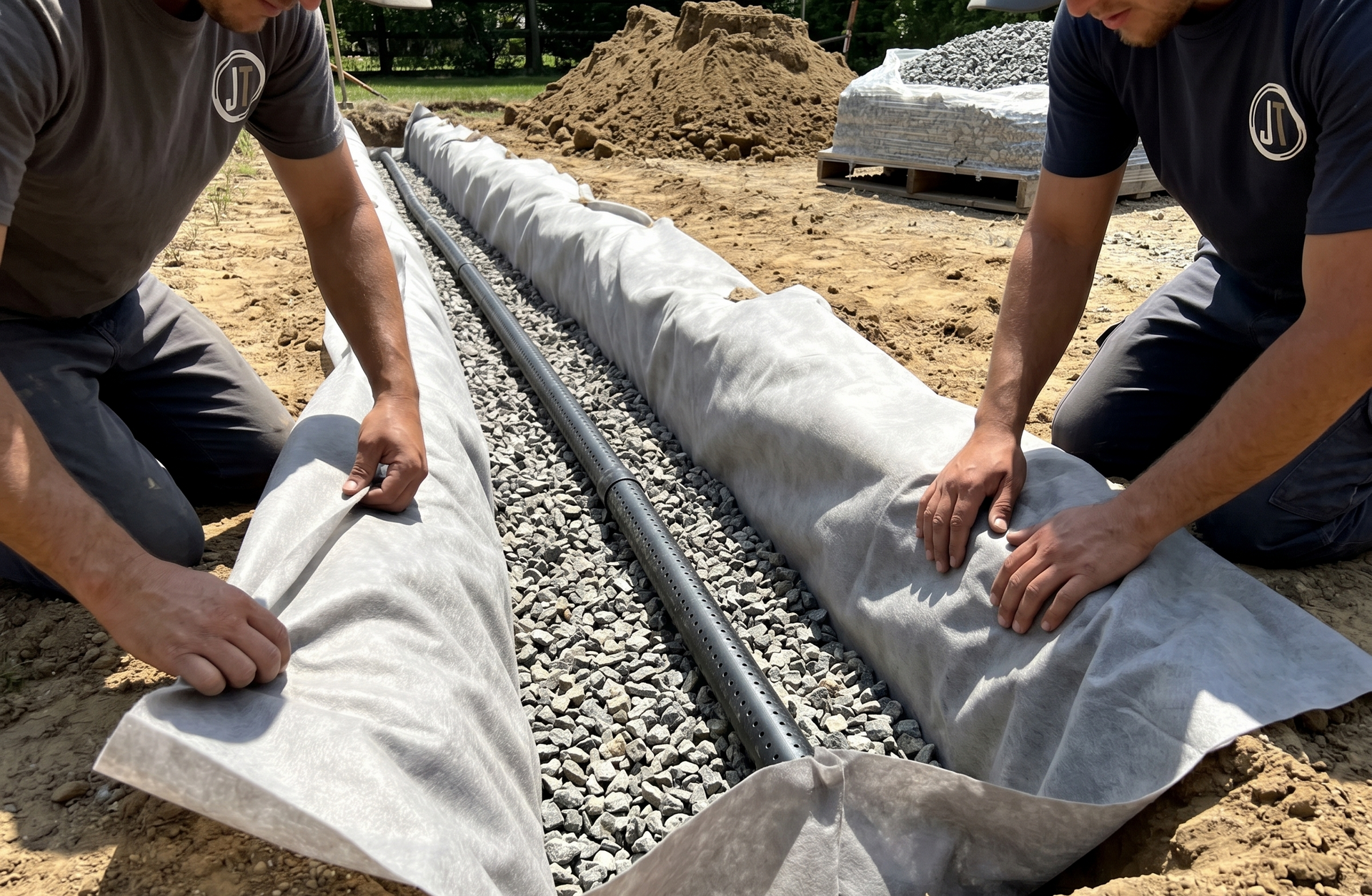
What drives drainage failure in Hicksville isn't any single factor — it's several working together. Smaller lots mean less permeable surface area to absorb rainfall before it becomes runoff. Older homes were often built without the subsurface drainage infrastructure that newer construction incorporates from the start. Nassau County's clay-heavy soil limits natural percolation regardless of lot size. And Long Island's shallow water table means the ground underneath Hicksville properties has limited capacity to absorb additional moisture before it backs up toward the surface.
A french drain is designed for environments where natural drainage has hit its ceiling. The system works below grade — a gravel-filled trench with a perforated pipe running its length — drawing in groundwater and redirecting it through a controlled path toward a safe discharge point, away from the foundation, any patio or retaining structure, and the low-lying sections of the yard where water tends to collect. It doesn't redirect the problem to a different part of the surface. It resolves it underground, before visible damage has a chance to take hold.
What that resolution produces is more than a functional yard. Basements that were accumulating moisture dry out because the exterior pressure driving that moisture has been eliminated. Patios and walkways stop shifting because the saturated soil undermining them has somewhere to drain. And outdoor spaces that were losing weeks of usability to standing water become functional again through the full season.
For beautiful walkways that stand the test of time, contact JT Masonry and Landscaping, schedule an appointment or call us at: (516) 732-5133
What Our French Drain Installation Process Looks Like
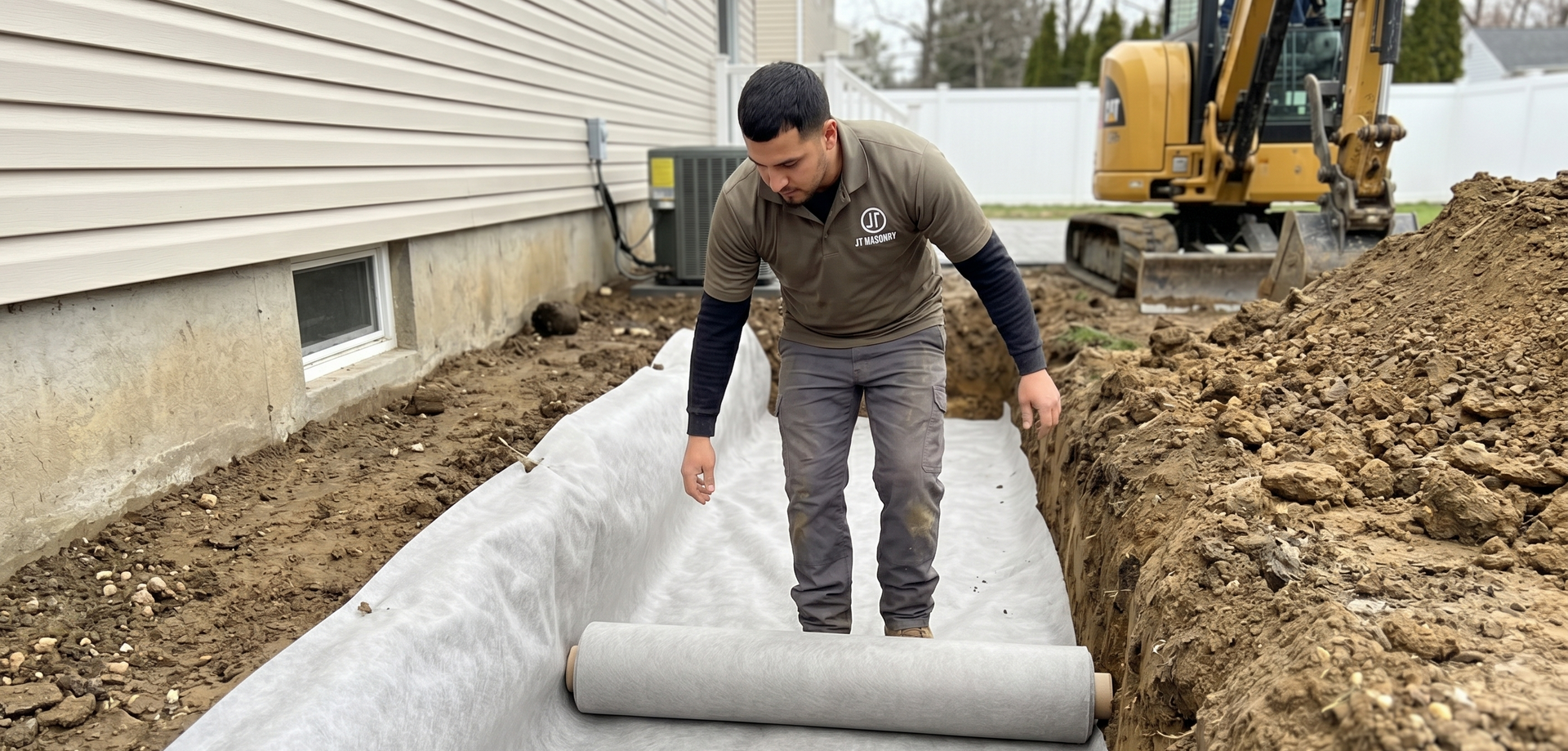
Hicksville lots may be smaller in footprint than properties elsewhere on Long Island, but drainage systems here still need to be designed for the specific conditions of each individual property — not adapted from a one-size-fits-all template. The way water enters a lot from the street, neighboring properties, or an adjacent driveway matters. Where existing structures, fences, and hardscape create barriers to natural flow matters. What discharge options are realistically available on a smaller lot matters. JT Masonry & Landscaping conducts an in-person site assessment for every french drain installation before any design is finalized, because those variables can't be evaluated any other way. Here's what the installation process involves once that assessment is complete:
✔ Utility location and site preparation. All underground utilities — gas, electrical, water, and any irrigation lines — are identified and marked through an 811 call before excavation begins. This is a firm first step on every project, regardless of lot size or scope.
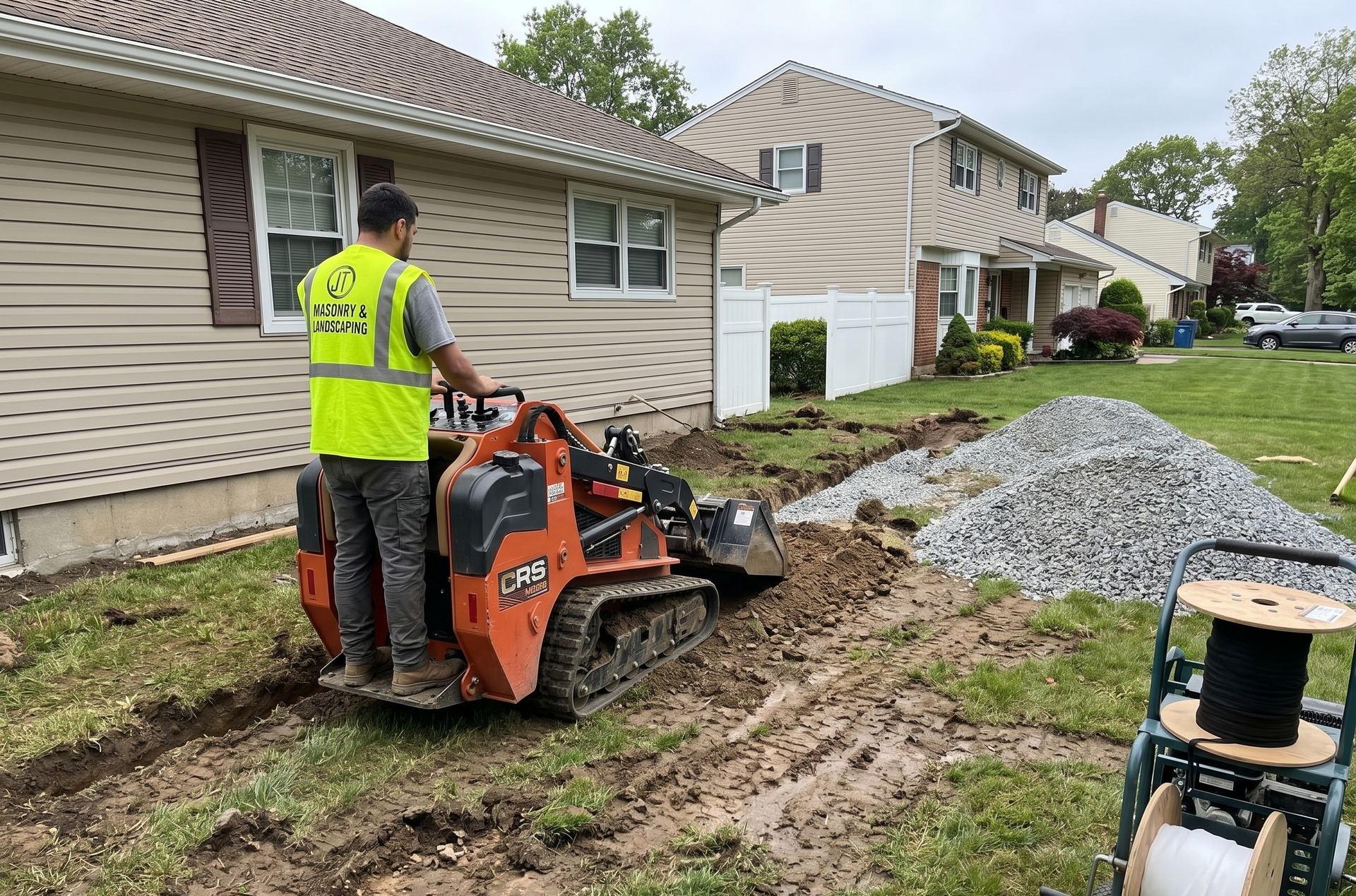
✔ Trench excavation along a calculated slope. The trench is cut to a depth of 18 to 24 inches and graded to maintain a minimum 1% slope — one inch of fall for every eight to ten feet — so water travels through the pipe continuously rather than stalling partway through the run.
✔ Filter fabric lining. Nonwoven geotextile fabric is installed throughout the trench before gravel placement, forming a barrier that prevents fine soil particles from migrating into the drainage bed over time. This step is what keeps the system functioning at capacity long after installation is complete.
✔ Gravel base and perforated pipe placement. Washed gravel establishes the foundation of the drainage bed. A rigid perforated pipe is then set in place with holes oriented downward — the orientation that maximizes water collection along the full length of the run — and gravel is packed in around and over it to complete the assembly.
✔ Proper discharge routing. Near the outlet end of the system, the perforated pipe transitions to solid piping that carries collected water to a designated discharge point — a dry well, drainage ditch, or pop-up emitter — positioned and routed to protect both the home and adjacent properties.
✔ Wrap, backfill, and restoration. The filter fabric is folded over the top of the gravel, the trench is backfilled with soil, and sod is restored over the surface. Once the work is finished, the system is entirely out of sight — the only indication it's there is a yard that handles rain the way it should.
The long-term performance of a french drain is determined by how precisely each of these steps is executed. Grade, material specification, and fabric installation are not areas where approximation produces acceptable results.
Frequently Asked Questions About French Drain Installation in Hicksville, NY
How long does a french drain installation take on a typical Long Island property?
The timeline for french drain installation depends on the length of the trench, the complexity of the routing, and the specific conditions of your property. Most residential installations on Long Island are completed within one to three days. During the initial consultation, JT Masonry provides a clear project timeline so you know exactly what to expect. We also coordinate around existing landscaping and hardscape features to minimize disruption to your yard during the process, and we leave the job site clean when the work is finished.
What type of pipe is used in a french drain?
Professional french drain installation typically uses rigid perforated PVC pipe or corrugated plastic pipe, usually 3.5 to 4 inches in diameter. At JT Masonry, the pipe selection is based on the volume of water the system needs to handle and the specific layout of your property. The perforated section of the pipe is installed with the holes facing downward, which allows groundwater to rise into the pipe from below rather than allowing soil sediment to fall in from above. The final section of the system transitions to solid pipe to carry collected water safely to the discharge point without any leakage along the way.
How much does french drain installation cost?
The cost of french drain installation varies based on several factors, including the total length of the trench, the depth required, soil conditions, accessibility of the work area, and the type of discharge point used. Because every Long Island property presents different challenges — from root systems and utility lines to soil composition and grade — we provide customized estimates rather than one-size-fits-all pricing. JT Masonry offers free on-site consultations where we evaluate your specific situation and provide a transparent, detailed estimate with no hidden fees. We also offer financing options to make drainage solutions accessible for homeowners.
Will a french drain damage my existing landscaping or hardscaping?
Some disruption to the yard surface is unavoidable during excavation, but a skilled installation crew minimizes the impact significantly. At JT Masonry, we carefully plan the trench route to avoid established plantings, irrigation lines, and hardscape features wherever possible. Once the french drain is installed and the trench is backfilled with soil and sod, the surface is restored and the system becomes virtually invisible. Our experience with both masonry and landscaping means we understand how to work around — and protect — the features you've already invested in, including patios, walkways, retaining walls, and pool areas.
How do I know if my property actually needs a french drain?
There are several reliable indicators that your property could benefit from french drain installation. Persistent standing water in your yard after rainstorms, damp or wet basement walls, efflorescence (white mineral deposits) on foundation surfaces, soggy or unusable sections of your lawn, and erosion around the base of your home or retaining walls are all signs that subsurface water isn't draining properly. If you've tried surface-level solutions like regrading or extending downspouts without lasting results, the problem is likely below the surface — which is exactly where a french drain operates. JT Masonry offers free property assessments to help you determine whether a french drain is the right solution for your specific drainage issue.ShareProject contentService Page Copy GeneratorCreated by youAdd PDFs, documents, or other text to reference in this project.
Why Hicksville Homeowners Trust JT Masonry for French Drain Installation
There's no shortage of contractors willing to put a pipe in the ground — the question is whether what they build will still be working correctly five or ten years from now. Hicksville homeowners who choose JT Masonry & Landscaping do so for reasons that hold up past the day the project is finished:
✔ Regional knowledge that only comes from 15 years on Long Island. Nassau County soil profiles, local water table behavior, and municipal code requirements aren't interchangeable with other markets. We've worked across Nassau and Suffolk County long enough to understand how drainage behaves differently in different parts of the Island — and to design systems that account for those differences.
✔ Masonry and hardscape expertise that informs drainage design. French drains rarely function independently of a property's other features. Patios, retaining walls, walkways, and driveways all interact with how water moves across a lot. Because JT Masonry builds those features, we approach drainage as part of the complete outdoor picture rather than treating it as a standalone problem.
✔ The owner is your contact throughout the entire project. No hand-offs to a crew you've never spoken to, no details lost between the sales call and the build. The owner remains personally involved from the initial walkthrough through the final inspection.
✔ Licensed, insured, and transparent before work begins. Every project is scoped in full prior to the start of any work. The scope is defined, the pricing is clear, and there are no additions that weren't part of the original conversation.
✔ A completed project portfolio of 200+ Long Island homeowners — built across drainage, masonry, and outdoor construction projects for clients who expected precision and received it.
Can I Install My Own French Drain in Hicksville?
The difference between a french drain that functions correctly for years and one that needs to be addressed within a season or two comes down entirely to execution. The trench slope has to be calculated and held consistently from one end of the run to the other — an insufficient grade doesn't just slow water movement, it stops it, and a pipe full of standing water isn't drainage. Gravel has to be specified for both permeability and particle size, because the wrong selection creates a path for fine sediment to infiltrate the drainage bed and gradually choke the system. Pipe diameter needs to reflect the actual volume of water the system will be managing — undersizing is one of the most common errors in DIY installations and one of the first things that fails under real storm conditions. And filter fabric that's applied carelessly or cut short doesn't protect the gravel bed the way the system depends on it to.
On a Hicksville property, as with any Long Island home, there's also the matter of what's already underground. Gas lines, water mains, electrical conduit, and in some cases older drainage infrastructure run at varying depths that can intersect directly with drainage excavation. Professional french drain installation on Long Island means the 811 utility locate is completed before any work begins — not as a procedural checkbox, but as a genuine safety measure that shapes how the excavation is planned. Knowing what's in the ground before digging into it is the baseline for any responsible drainage project.
For homeowners who want the water problem resolved correctly and permanently, professional installation is consistently the approach that produces that outcome.
What Are the Downsides of a French Drain?
Understanding what a french drain installation actually involves — before committing to it — leads to better planning and a smoother project experience. The work is subsurface by nature, which means excavation is required and a defined portion of the yard will be out of use while the system is being built. On a smaller Hicksville lot, that temporary disruption may feel more noticeable than it would on a larger property, which is worth discussing openly during the initial consultation so the restoration plan is understood clearly from the start. Cost is the other variable to factor in — though it tends to look more manageable when placed alongside the real alternatives. Foundation repair, basement waterproofing, and structural hardscape reconstruction are among the most disruptive and expensive property repairs available, and in the majority of cases, they're the direct downstream consequence of drainage problems that could have been corrected far more affordably before they escalated.
Well-built french drains are low-maintenance systems, but the discharge outlet benefits from occasional inspection over the life of the installation. Debris accumulation and root intrusion near the outlet end are the most common causes of reduced flow in systems that were otherwise installed correctly. Both are simple to address when the pipe routing and fabric installation were done thoughtfully at the outset — which is why those decisions carry the weight they do during every installation we manage.
Put plainly: a finite disruption and a defined upfront investment, measured against compounding structural damage and deteriorating property value that develops when drainage problems are left to run their course. For most homeowners who think through that comparison honestly, the path forward is clear.
How Deep Should a French Drain Be Placed?
What depth a french drain needs to reach is a function of what it's being asked to accomplish — there's no fixed specification that applies universally across every property or every drainage problem. For yard drainage and general subsurface water management, 18 to 24 inches is the standard working depth, placing the perforated pipe below the root zone where it can intercept groundwater before saturation builds toward the surface. Foundation drainage applications require a different calculation: the trench has to reach the depth of the foundation footer to cut off water before hydrostatic pressure develops against the wall, and on older Hicksville homes — many of which were built with basements during the post-war development era — that can mean excavating beyond standard yard drainage depth depending on the home's construction. Trench width typically falls between 9 and 12 inches, providing adequate room for the gravel bed and pipe assembly without requiring more disruption to the surrounding area than the installation warrants.
For properties throughout Hicksville and central Nassau County, JT Masonry works through the specific variables at each property during the initial on-site consultation before any depth or configuration decisions are committed to. Soil conditions, the nature and pattern of the drainage problem, the drain's positioning relative to the home's foundation, and the discharge options available on the lot all factor into what the final design looks like. No two properties produce the same answer, and an assessment conducted at your specific property is the only reliable way to arrive at the right one.
Who Benefits Most from French Drain Installation in Hicksville?
French drain installation on Long Island addresses a wide range of drainage situations, and in a densely developed community like Hicksville, the circumstances that call for one are more common than many homeowners might expect:
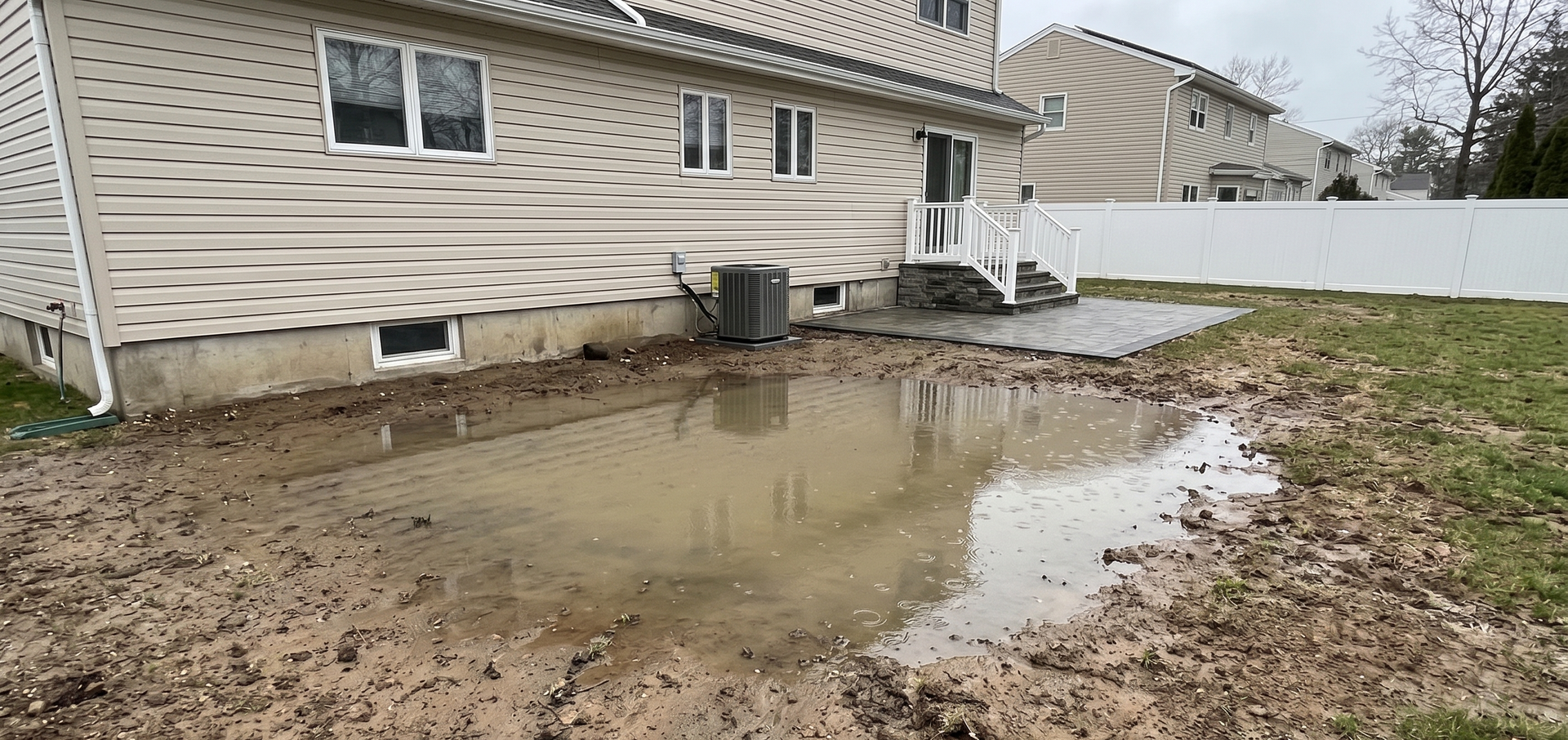
Basement moisture or water intrusion that appears consistently after heavy rain is rarely a coincidence — it almost always reflects inadequate exterior drainage allowing groundwater to accumulate against the foundation wall. A french drain installed along the perimeter captures that water before it reaches the structure, resolving the underlying pressure rather than treating the symptom inside the home. Yards where surface water pools in the same spots after every storm — areas that stay soft for days and never seem to fully recover between rain events — are a direct indication that subsurface drainage capacity has been exceeded. A french drain intercepts that water below grade and routes it to a controlled outlet, restoring the yard's function rather than leaving it to the mercy of whatever the next storm brings. For homeowners who have added patios, retaining walls, walkways, or other hardscape improvements, drainage is the underlying protection those features depend on — water-saturated soil erodes the base beneath them and leads to the kind of shifting, settling, and cracking that turns a finished outdoor space into a repair project.
Hicksville homeowners planning any outdoor renovation or addition are also well positioned to incorporate drainage during the project itself. Building it in alongside other work is significantly more efficient and cost-effective than treating it as a separate project after everything else is finished.
Long-Term Value of Professional French Drain Installation in Hicksville, NY
The return on a professionally installed french drain accumulates quietly — not in what it adds visibly to the property, but in what it removes from the list of things that go wrong. A basement that stopped showing moisture after rain. A patio that has held its level through three winters because the soil beneath it is draining properly. A foundation that isn't developing the cracks that start small and grow expensive. A yard that recovers from heavy rain in hours rather than sitting waterlogged for days. Each of these outcomes is invisible in the way that prevention always is — but the absence of those problems has real financial value, and it compounds the longer the system is in place.
For Hicksville homeowners, that value also shows up when it matters most: at the point of sale. Drainage failures are among the most common red flags surfaced during a home inspection, and they affect both buyer confidence and final sale price in ways that can significantly exceed what a drainage system would have cost to install. A property where drainage has been professionally addressed — reflected in a dry foundation, intact hardscape, and a yard that handles Long Island weather the way it should — carries a different profile in the market than one where those problems remain unresolved. For homeowners thinking about both the daily livability of their property and where it stands long-term, that combination makes french drain installation one of the more straightforward investments available.
Get a Free French Drain Installation Estimate in
Hicksville, NY
If standing water, foundation moisture, or drainage that simply can't keep pace with Long Island rainfall is affecting your Hicksville property, the cost of waiting consistently outpaces the cost of acting. JT Masonry & Landscaping offers free, on-site estimates for french drain installation across Nassau and Suffolk County, and Hicksville is well within the communities we serve on a regular basis. We'll come to your property, evaluate what's actually driving the drainage problem, and put together a system designed specifically for the conditions on your lot — not a standard approach applied without regard for what's happening on the ground.
Call us at (516) 732-5133 or submit your estimate request online. We respond within 24 hours.