

French Drain Installation in East Meadow, NY
Stop Water Damage Before It Starts — Professional Drainage Solutions for East Meadow Homeowners
East Meadow sits at the geographic center of Nassau County — a well-established community built around mid-century residential development, modest lot sizes, and the kind of flat, densely settled terrain that gives water very little encouragement to move anywhere on its own. Eisenhower Park borders the community to the north, and much of the surrounding landscape shares the same characteristics: level ground, clay-influenced soil, and a subsurface environment that reaches saturation quickly and recovers slowly. For homeowners here, that combination translates directly into drainage challenges that show up after every significant storm and compound season after season without intervention. French drain installation on Long Island is one of the most effective ways to break that cycle, and JT Masonry & Landscaping has been providing that solution to homeowners across Nassau and Suffolk County for over 15 years. What consistent work in this region has shown, without exception, is that water finding its own path through a property never finds a good one — and the damage it causes along the way is always more expensive than the drainage system that would have prevented it.

Contact JT Masonry and Landscaping!
Our team is ready to turn your vision into reality, creating stunning landscapes and enduring masonry structures.
Website Lead Form (Stone Veneers Page)

CLIENT REVIEWS
WHAT OUR CLIENTS ARE SAYING
JT Masonary and landscaping were exceptional right from the first point of contact to the completion of their work. The owner JUSTIN was very professional in the way he presented the work he was going to do. The workers were polite, efficient, and hard-working. And the results of their work was phenomenal! We are already considering them for another job. Thank you JUSTIN and Company.
We had a great experience with Justin and the crew at JT Masonry & Landscaping. We got a inground pool and pavers installed. They made it easy every step of the way from the planning stage to our first pool opening. We would definitely recommend this company to family and friends.


How French Drain Installation in East Meadow Solves Your Property's Biggest Water Problems
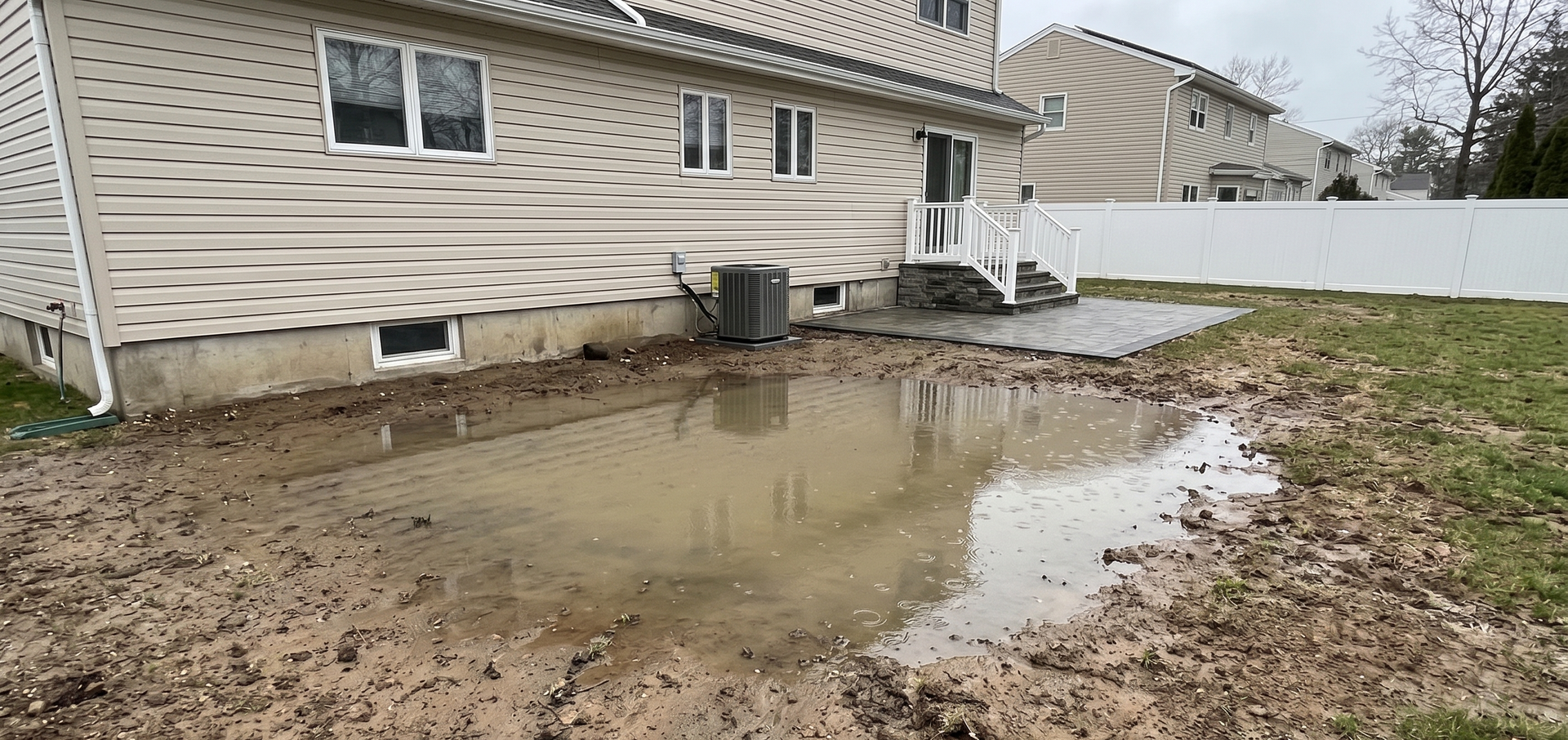
East Meadow's drainage challenges are baked into the landscape itself. The community's central Nassau location means it sits well away from the coastal features that some homeowners associate with water problems — but proximity to the South Shore or bay isn't a prerequisite for poor drainage. Flat topography removes the natural grade that would otherwise move water away from structures. Nassau County's clay-heavy soils absorb rainfall at a fraction of the rate that sandier or loamier soil profiles would. And residential density means that impervious surfaces — driveways, sidewalks, patios — redirect water onto already-limited permeable ground rather than allowing it to disperse naturally. The result is ground that saturates quickly and stays that way long after the rain has stopped.
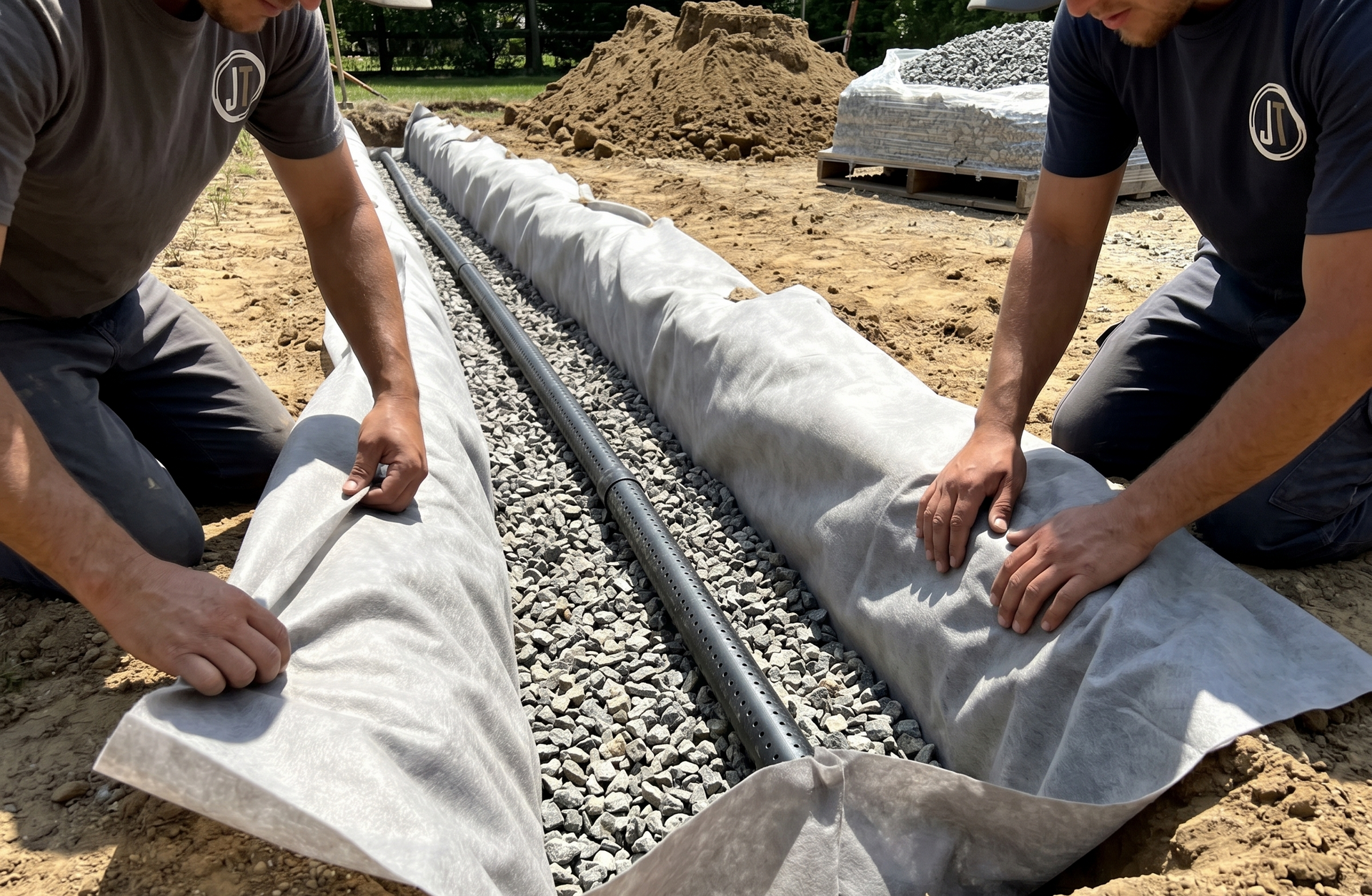
A french drain addresses this through a subsurface system: a trench packed with washed gravel housing a perforated pipe that draws groundwater in and channels it along a controlled path toward a designated discharge point. The intervention happens below grade, working on the water where it actually accumulates rather than at the surface where it becomes visible. It doesn't shift the problem — it removes it.
What comes from that is meaningful on multiple levels. Outdoor spaces that currently sit under water for days after a storm reclaim their function throughout the season. Soil that drains consistently provides a reliable base for patios and retaining walls instead of eroding beneath them. And the interior moisture issues that wet foundations produce — damp basement walls, mold conditions, efflorescence — are addressed at their exterior source rather than managed symptom by symptom inside the home.
For beautiful walkways that stand the test of time, contact JT Masonry and Landscaping, schedule an appointment or call us at: (516) 732-5133
What Our French Drain Installation Process Looks Like
Even within a single community, no two East Meadow properties drain identically. The position of the home on the lot, the grade relationship between the structure and the street, how neighboring properties shed water, the placement of existing hardscape, and what discharge options are realistically available all shape what a drainage system needs to look like to actually work. That's why every french drain installation JT Masonry & Landscaping handles begins with a direct site visit — not a phone consultation or an estimate built on square footage alone. We evaluate how water moves across your specific property, identify the failure points, and design a system that addresses them. From that point, installation follows a defined sequence:
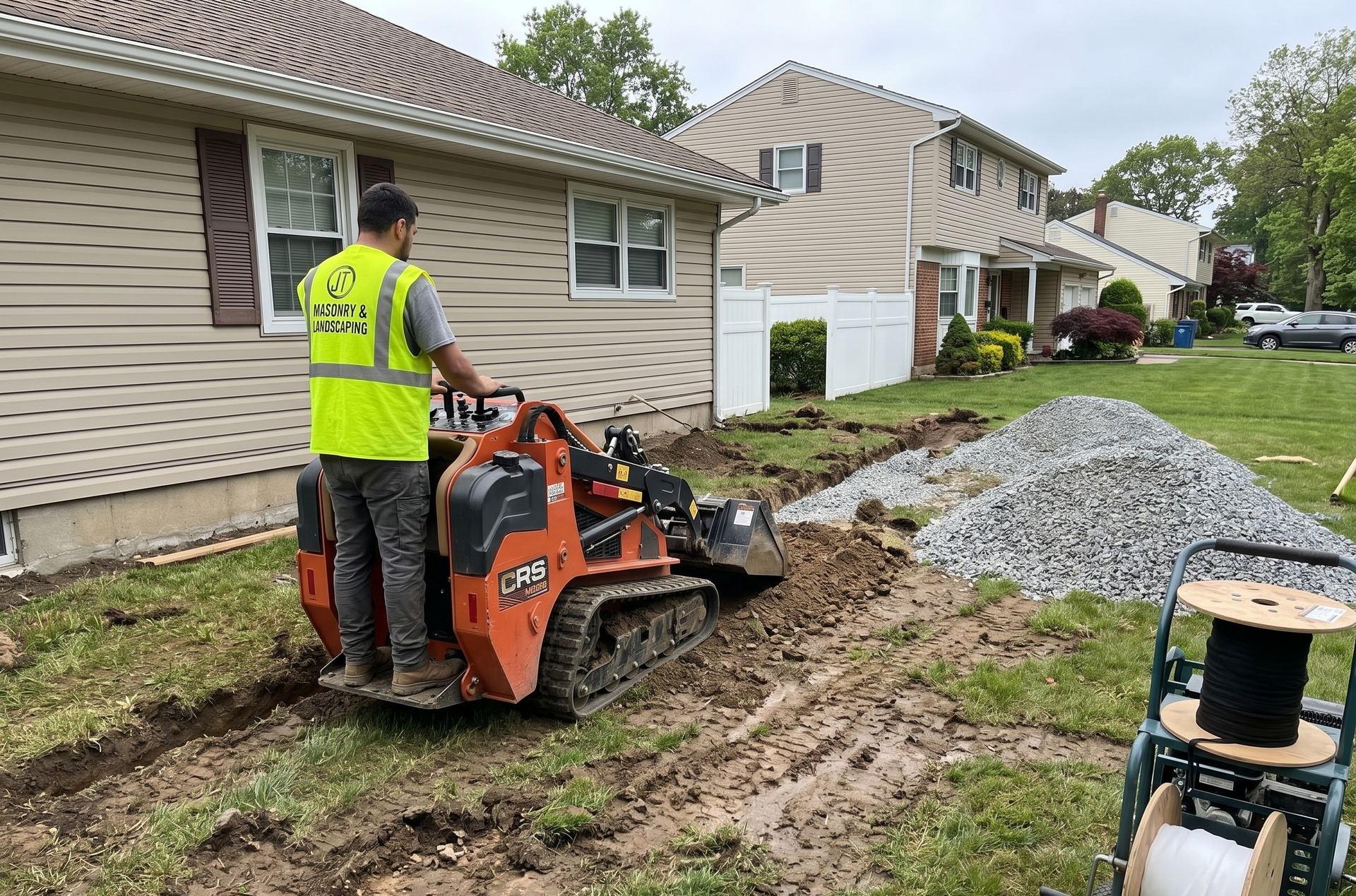
✔ Utility location and site preparation. Before excavation begins, an 811 utility locate is completed and all underground lines — gas, electrical, water, and irrigation — are identified and marked. No digging starts until every subsurface line is accounted for. This is a firm first step on every project.
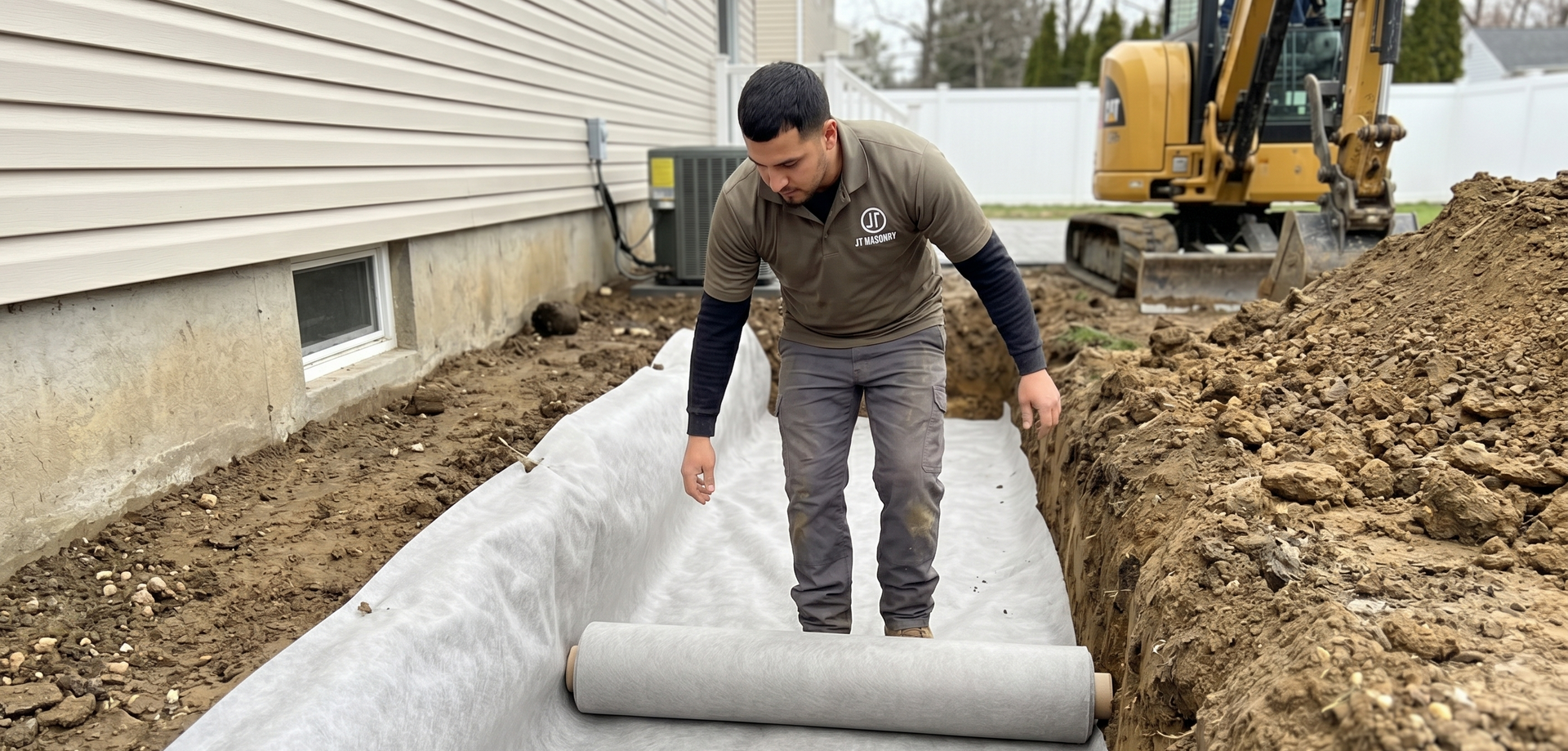
✔ Trench excavation along a calculated slope. The trench is cut to a depth of 18 to 24 inches and graded at a minimum 1% slope — one inch of fall for every eight to ten feet of run — maintaining the consistent pitch that keeps water moving through the pipe rather than sitting inside it.
✔ Filter fabric lining. Nonwoven geotextile fabric is installed throughout the full interior of the trench before any gravel is placed. This layer forms a barrier against fine soil and silt migration into the drainage bed — the mechanism that gradually degrades system performance in installations where it was skipped or improperly applied.
✔ Gravel base and perforated pipe placement. A layer of washed gravel establishes the drainage bed. A rigid perforated pipe is positioned with holes facing downward to maximize water collection, then surrounded with additional gravel to complete the assembly. The orientation and gravel coverage both matter for how efficiently the system collects water across its full length.
✔ Proper discharge routing. Near the outlet end of the run, solid piping takes over from the perforated section, carrying collected water to a designated discharge point — a dry well, drainage ditch, or pop-up emitter — selected to safely remove water from the property without impacting adjacent lots or violating local code requirements.
✔ Wrap, backfill, and restoration. The filter fabric is folded over the gravel, the trench is backfilled, and the surface is restored with sod. Once complete, the system is fully out of sight. The only thing that changes is how the yard responds to rain.
How well a french drain performs five and ten years from now is a direct product of how carefully each of these steps was executed. The grade, material specification, and fabric installation are invisible once the ground is closed — but they're the variables that everything else depends on.
Frequently Asked Questions About French Drain Installation in East Meadow, NY
How long does a french drain installation take on a typical Long Island property?
The timeline for french drain installation depends on the length of the trench, the complexity of the routing, and the specific conditions of your property. Most residential installations on Long Island are completed within one to three days. During the initial consultation, JT Masonry provides a clear project timeline so you know exactly what to expect. We also coordinate around existing landscaping and hardscape features to minimize disruption to your yard during the process, and we leave the job site clean when the work is finished.
What type of pipe is used in a french drain?
Professional french drain installation typically uses rigid perforated PVC pipe or corrugated plastic pipe, usually 3.5 to 4 inches in diameter. At JT Masonry, the pipe selection is based on the volume of water the system needs to handle and the specific layout of your property. The perforated section of the pipe is installed with the holes facing downward, which allows groundwater to rise into the pipe from below rather than allowing soil sediment to fall in from above. The final section of the system transitions to solid pipe to carry collected water safely to the discharge point without any leakage along the way.
How much does french drain installation cost?
The cost of french drain installation varies based on several factors, including the total length of the trench, the depth required, soil conditions, accessibility of the work area, and the type of discharge point used. Because every Long Island property presents different challenges — from root systems and utility lines to soil composition and grade — we provide customized estimates rather than one-size-fits-all pricing. JT Masonry offers free on-site consultations where we evaluate your specific situation and provide a transparent, detailed estimate with no hidden fees. We also offer financing options to make drainage solutions accessible for homeowners.
Will a french drain damage my existing landscaping or hardscaping?
Some disruption to the yard surface is unavoidable during excavation, but a skilled installation crew minimizes the impact significantly. At JT Masonry, we carefully plan the trench route to avoid established plantings, irrigation lines, and hardscape features wherever possible. Once the french drain is installed and the trench is backfilled with soil and sod, the surface is restored and the system becomes virtually invisible. Our experience with both masonry and landscaping means we understand how to work around — and protect — the features you've already invested in, including patios, walkways, retaining walls, and pool areas.
How do I know if my property actually needs a french drain?
There are several reliable indicators that your property could benefit from french drain installation. Persistent standing water in your yard after rainstorms, damp or wet basement walls, efflorescence (white mineral deposits) on foundation surfaces, soggy or unusable sections of your lawn, and erosion around the base of your home or retaining walls are all signs that subsurface water isn't draining properly. If you've tried surface-level solutions like regrading or extending downspouts without lasting results, the problem is likely below the surface — which is exactly where a french drain operates. JT Masonry offers free property assessments to help you determine whether a french drain is the right solution for your specific drainage issue.ShareProject contentService Page Copy GeneratorCreated by youAdd PDFs, documents, or other text to reference in this project.
Why East Meadow Homeowners Trust JT Masonry for French Drain Installation
When it comes to french drain installation, the decisions that matter most are made before the first trench is cut — during design, during material selection, and during the assessment that shapes both. East Meadow homeowners who work with JT Masonry & Landscaping consistently come back to the same reasons:
✔ Regional experience built over 15 years on Long Island. Nassau County soil behavior, water table patterns, and municipal code requirements don't replicate cleanly from other markets. Understanding how drainage conditions shift across different parts of the Island — and what that means for system design — comes from years of consistent work here, not from general drainage knowledge applied to a new geography.
✔ Integrated masonry and hardscape perspective. The way a patio drains, how a retaining wall interacts with subsurface water movement, where a driveway pushes runoff — all of these influence what a drainage system has to accomplish. Because JT Masonry designs and builds those outdoor features directly, our drainage solutions account for the full property, not just the drainage problem viewed in isolation.
✔ Direct owner involvement on every project. From the first phone call through final walkthrough, you work with the owner — not a project coordinator relaying information between you and a crew you've never met. The continuity of that relationship is how what gets discussed in the consultation becomes what actually gets installed.
✔ Licensed, insured, and specific about scope before work begins. Every project is fully evaluated and priced before a shovel enters the ground. What's in the scope is what gets built — no additions that weren't part of the original conversation.
✔ A track record of 200+ completed Long Island projects spanning drainage, masonry, and outdoor construction — built on results that perform and clients who refer their neighbors without being prompted.
Can I Install My Own French Drain in East Meadow?
The gap between a french drain that handles Long Island weather effectively for a decade and one that starts failing within a season or two isn't a matter of luck — it's a matter of how precisely the installation was executed. Slope is the variable most commonly underestimated: insufficient grade across any portion of the run leaves water stalled inside the pipe, and a pipe that holds water isn't draining anything. Gravel specification determines both how freely water moves into and through the drainage bed and how resistant the system is to long-term sediment infiltration. Filter fabric applied without full coverage or proper overlap doesn't protect the gravel bed the way the system depends on it to — and once sediment begins infiltrating, the capacity loss is gradual, invisible, and cumulative. Pipe diameter that doesn't account for peak water volume handles ordinary rainfall adequately but falls short during the storm events the system was actually installed to manage.
These aren't edge cases. They're the most predictable failure modes in drainage installations that weren't approached with the precision the work requires — and in a flat, clay-soil environment like East Meadow, where the system is working against natural drainage limitations from the start, those failure modes show up faster than they might elsewhere.
There's also the utility question that applies to any Long Island property. Gas service, water mains, electrical conduit, and irrigation lines run at depths that intersect directly with drainage excavation — and on an established Nassau County residential street, the density of that buried infrastructure can be significant. Professional french drain installation on Long Island means the 811 locate is completed before any work begins, every underground line is mapped, and excavation is planned around what's actually in the ground. That's not a precaution — it's the baseline for any responsible drainage project.
What Are the Downsides of a French Drain?
Knowing what a french drain installation actually involves — before signing on — sets the project up for a smoother experience and clearer expectations on both sides. The work is inherently subsurface, which means excavation is required and a section of the yard will be out of commission for the duration of the installation. For East Meadow homeowners with smaller lots where outdoor space is used actively through the season, it's worth mapping out the restoration plan during the initial consultation so the timeline and scope of disruption are understood before work begins. Professional installation carries a cost — but that number reads differently when it's placed alongside what foundation repair, basement waterproofing, and structural hardscape reconstruction actually run when water damage is allowed to develop across a season or two. Those outcomes aren't hypothetical — they're the documented downstream consequence of drainage problems that were addressable far more economically before they escalated.
Well-executed french drains are low-maintenance systems, but not entirely maintenance-free. The discharge outlet is the one component worth monitoring periodically over the life of the system — debris accumulation and root intrusion near the outlet end are the most common sources of reduced flow in otherwise sound installations. Both are straightforward to address when the system was designed with quality filter fabric application and deliberate pipe routing from the start. Those upfront decisions are what keep the long-term maintenance requirement minimal and the system running at capacity year after year.
The trade-off is consistent and uncomplicated: a temporary disruption and a transparent upfront cost, against structural deterioration and property value loss that compounds the longer a drainage problem is left unresolved.
How Deep Should a French Drain Be Placed?
Correct depth for a french drain isn't determined by a standard specification — it's determined by what the system needs to accomplish and what conditions exist at that specific property. For general yard drainage and subsurface water management, 18 to 24 inches is the working standard, positioning the perforated pipe below the root zone and within the range where groundwater can be captured before it saturates the soil above. Foundation drainage applications require a different calculation: the trench has to reach the depth of the foundation footer to intercept water before hydrostatic pressure builds against the structure. For homes throughout East Meadow — many of which were constructed during the post-war building era and include full or partial basements — the appropriate depth for foundation protection will vary based on the home's original construction and the depth of its footings. Trench width typically falls between 9 and 12 inches, providing room for the gravel bed, pipe, and surrounding fill without creating more disruption than the installation requires.
For East Meadow properties, JT Masonry works through the depth and configuration questions during the initial on-site consultation before any design decisions are committed to. Soil conditions, the nature and severity of the water problem, where the drain needs to be positioned relative to the home, and what discharge options the lot can realistically support all factor into the final design. Those variables produce different answers on different properties — which is why accurate depth decisions have to come from an assessment conducted at your specific lot, not from a number selected in advance of seeing it.
Who Benefits Most from French Drain Installation in East Meadow?
French drain installation on Long Island addresses a broad range of drainage situations — and in a centrally located, densely developed community like East Meadow, where flat terrain and clay soil mean water has limited places to go after a storm, the situations that warrant one are encountered more often than many homeowners expect:
Basement moisture or seepage that materializes consistently after heavy rainfall almost always traces back to exterior drainage inadequacy rather than a failure inside the home. A french drain installed along the foundation perimeter captures groundwater before it accumulates against the exterior wall, eliminating the pressure that drives moisture inward and addressing the issue at its origin. Yards with persistent low spots or sections that collect surface water and sit waterlogged for days following a storm are a direct signal that subsurface drainage capacity has been exceeded — a french drain intercepts that water below grade and routes it to a controlled outlet, restoring the yard's usability across the full season rather than leaving sections of it effectively out of service after every significant rain. For homeowners who have added hardscape improvements — a patio, retaining wall, walkway, or driveway extension — drainage is the underlying infrastructure those features depend on to stay structurally sound. Water-saturated soil erodes the base beneath them and eventually produces the settling, shifting, and surface cracking that turns finished outdoor improvements into repair projects.
Homeowners in East Meadow who are planning any renovation or outdoor construction project are also in the best position to incorporate drainage during the build itself — before other features are finished around it. The cost and disruption of retrofitting drainage after everything else is in place is consistently higher than integrating it as part of the original project.
Long-Term Value of Professional French Drain Installation in East Meadow, NY
The value a professionally installed french drain delivers doesn't show up in a single dramatic before-and-after — it accumulates steadily, in the form of problems that don't develop. A basement that holds dry through a wet spring. A patio that stays level across multiple winters because the soil beneath it drains consistently. A foundation that isn't developing the hairline cracks that compound over time. A lawn that recovers from a heavy rain in hours rather than sitting underwater for days. None of these outcomes are visible in the conventional sense — but each one represents real, tangible value that builds across the years the system is in place.
That value also surfaces at the point of sale. In East Meadow's active Nassau County real estate market, home inspections surface drainage problems reliably — and buyers factor what they find into both their offer and their confidence in the property. A home where drainage has been professionally addressed carries a different profile than one where water issues remain unresolved and visible. A dry foundation, intact and level hardscaping, and a yard that handles Long Island weather without chronic saturation communicate something clear about how the property has been maintained. For homeowners thinking simultaneously about day-to-day livability and long-term market position, that combination makes french drain installation one of the more purposeful investments available in a Nassau County home.
Get a Free French Drain Installation Estimate in
East Meadow, NY
East Meadow homeowners dealing with standing water, foundation moisture, or drainage that can't keep pace with Nassau County's rainfall don't have to keep managing the consequences of a problem that has a clear solution. JT Masonry & Landscaping provides free, on-site estimates for french drain installation across Nassau and Suffolk County, and East Meadow is well within the communities we serve on a regular basis. We'll come to your property, assess what's actually driving the drainage issue, and design a system built specifically for the conditions on your lot — not a standardized approach applied without regard for what we observe on the ground.
Call us at (516) 732-5133 or submit your estimate request online. We respond within 24 hours.